W3 Series 30 · Intended / Planned
Robotics DAO
Governing the commercial deployment of robotic and physical-AI agents — as stated on the Foundation site. Planned, not yet formed.
The AGI Future Foundation is a California Nonprofit Public Benefit Corporation, Entity No. B20260196664, Articles filed 2026-04-24, EIN assigned 2026-05-07. No IRS 501(c)(3) determination letter is in the Foundation's files, so the Foundation does not claim tax-exempt status and does not claim that donations to it are tax-deductible. Nothing on this page is an offer of securities, an investment solicitation, or legal, tax, or financial advice.
What this series is
Robotics DAO is W3 Series 30, and it is the best-documented series in this group — which still means very little is verified. The April 2026 internal W3 series list names “W3 LLC-Robotics DAO — Series 30”. The Foundation's own site goes one step further than it does for the other series in this group: its article summary for the Robotics DAO investment thesis describes the series as “governing commercial deployment of robotic and physical-AI agents.” That sentence is site copy, labelled as such here, and it is the full extent of the published description. There is no verified product, no deployed robot, no customer, no partner, no site, no revenue, and no team on record, and this page claims none of those things.
The planned focus, as stated on the Foundation site, is governance of deployment — not building robots, and not selling them. That distinction is the point of the series, and it is worth dwelling on. Physical AI is AI that acts in the world: it moves, lifts, drives, handles materials, and works alongside people. When it fails, the failure is physical, not just informational. A series that governs commercial deployment would therefore be concerned with questions that a software-only series never faces: where a robot may operate, under whose supervision, with what safety interlocks, with what liability if it harms a person or damages property, and with what recourse for the people working next to it. Those are governance questions before they are engineering questions, and they are the reason the series is framed as a DAO with a human Steward Council rather than as a robotics company.
The commercial side of the planned focus is equally specific in what it does not say. “Commercial deployment” implies robots working for paying customers in real settings — warehouses, sites, facilities — rather than demonstrations. But no deployment exists, no customer has been named, no site has been acquired or leased, and no order or pilot has been signed. The Foundation's wider SmartCiti.X planning (Series 10) discusses robotics training, robotics manufacturing, and site acquisition as part of a proposed $10M raise for a new SmartCiti.X corporation, but that is a separate proposed corporation, not this series, and no part of it has been formed, funded, or offered either. This page does not borrow SmartCiti.X's plans and present them as Robotics DAO's achievements. If Robotics DAO ever governs deployments, the deployments it governs would need to be named, dated, and verified one by one; until then, “commercial deployment” is a planned mandate, not a track record.
What the series would have to get right, if it ever operates, follows directly from the physical stakes. Safety would come before speed: pre-registered safety thresholds, independent evaluation of the systems being deployed, and the power to refuse or halt a deployment that fails its checks — the same Alignment Evaluation Gate pattern the Foundation describes for models, applied to machines that move. Liability would need to be written down before deployment, not discovered after an incident: who is responsible when a robot errs, the operator, the deployer, or the manufacturer, and what insurance and remedy exist. Labour would need to be part of the design, not an afterthought: the people whose workplaces gain robots deserve a say in how deployment happens, and any claim about training or jobs would need a signed agreement with a real workforce body before it is stated. And every deployment would need a human accountable on site, by name, because a DAO cannot be present when a machine fails. None of these arrangements exists today. They are the standard the series would be measured against, listed here so that a future reviewer can check them — not to imply they have been met.
Validation for Robotics DAO would be the most demanding in the network, because the failure mode is physical. It would not be enough to show a robot working in a video; validation would mean a deployment operating under the DAO's rules, with safety checks passed, liability assigned, workers consulted, and an incident record that is published rather than hidden. The planned sequence is deliberately slow: written deployment standards first, reviewed by counsel and by safety experts; then a single small pilot, with a named human accountable and a named site; then a published review of what happened, including what went wrong; and only then any discussion of a second deployment. A series that scales before it has published one honest pilot review has skipped the step that justifies its existence. That discipline is also why this page, the fullest in the group, still ends in the same place as the thinnest: the series is intended and planned, not formed, funded, or offered.
Metaverse connection
Robotics DAO has no anchored metaverse fabric and no wallet, contract, chain, token, members, or votes on record. No coordinates, no fabric URL, no world, and no RP1 status exist for this series, and none is claimed here. Zero worlds are live on RP1. The six anchored worlds in the Foundation's network belong to SmartCiti.X, Cognition.X, Locator.X, Biota.blockchain (unnumbered), Empathic.X, and Diagnostic.X — none of them is this series. That absence is worth stating plainly, because a physical-AI series is the one readers might most expect to have a digital twin or a training world, and it has neither. If a metaverse presence were ever proposed — for example, a simulation environment for training or evaluation — what would be needed first is a defined fabric, a stated purpose, and a clear statement of what is simulated and what is not, so that simulation results are never presented as real-world deployment evidence. None of that exists today.
That is the complete, verified statement of this series' metaverse position. There is nothing further to add, because there is nothing further on record: no fabric, no coordinates, no world, no contract, no token, no members, and no votes. If any of that changes, this page should be updated with the dated evidence — a fabric address, a world identifier, a transaction record — rather than with a new claim. Until then, the absence is the fact, and this page reports it.
One registry link does exist and is recorded here so the absence above is not overstated: agi-corp-worlds’ series registry (worlds/series.json) lists a world entry for this series (robotics-dao), one of only seven series with such a link. A registry link is not an anchored fabric, a flagship, or a live world — there are still no coordinates, no fabric JSON, and no RP1 attach for this series — but the link is real and is stated here rather than hidden.
Visit in VR
This series has no flagship world in the worlds-3d lobby and no live world on RP1 — zero worlds are live on RP1. What it does have is a listing: the worlds-3d lobby’s searchable index of 544 WorldForge worlds carries a curated entry for this series under the slug robotics-dao. That entry is an index listing, not a playable world, and it should not be read as one.
To look around the Foundation’s VR spaces, start at the Foundation VR tour, or browse the full 544-world index at the worlds-3d lobby and search for the slug above. The seven playable flagship worlds in the lobby are the AGI Corp Hub, Biota.blockchain, Cognition.X, Diagnostic.X, Empathic.X, Locator.X, and the SmartCiti.X Holodeck — none of them is this series.
One registry link does exist for this series: agi-corp-worlds’ series registry lists a world entry for Robotics DAO (robotics-dao), one of only seven series with such a link, and the 544-world index carries it under that same slug. A registry link is not an anchored fabric, though: there is still no flagship fabric JSON, no coordinates, and no RP1 attach for this series, and the simulator seats and agent cards listed under Code and repositories below are training and governance tooling, not a live world.
What exists today vs what is planned
What exists today
One line on an internal list: the April 2026 W3 series list names this series and its number. The Foundation itself is verified as filed (see the status note above). That is the complete inventory. There is no formed series entity, no designation document, no operating agreement, no Steward Council, no bank account, no product, no users, no revenue, no partners, no customers, no sites, and no timeline. This page does not present a plan as an achievement, and it does not fill the empty inventory with plausible-sounding detail.
What is planned
A DAO-managed series in the intended W3 network, operating day to day through agents within human-set limits, with a human Steward Council deciding, signing, and moving funds, and with the Foundation as mission gate under written agreements. Before any of that can happen, the series needs a written statement of purpose, a designated legal form, counsel's review, a named steward, and a first stage-gate decision. Each of those is a human decision with a dated record. None has been made yet.
The gap between the two cards above is the work. It is normal for a planned series to have that gap; what would not be normal is pretending it does not exist. Readers, reviewers, and potential stewards should judge this series by what is on record, and should ask for the dated record behind any future claim that the gap has closed.
How it fits
This series sits in the third tier of the Foundation's intended three-tier architecture. The apex tier is governance: the AGI Future Foundation itself, a California nonprofit public benefit corporation, holding the Fiduciary Shield and the mission standard. The middle tier is the commercial engine: W3 LLC, an intended Wyoming series LLC, which would house the individual series as legally segregated sub-series with isolated assets and liability. The third tier is the series themselves — this page among them — each a specialised, agent-operated DAO within its own lane. The tier structure is the plan; only the apex tier is verified as filed. The middle tier and this series are intended, not formed.
Related series (planned relationships only; no agreements exist):
- SmartCiti.X (Series 10) — see that series page.
- Cognition.X (Series 1) — see that series page.
- Aerospace DAO (Series 31) — see that series page.
The closest planned relationships are with SmartCiti.X (Series 10), whose proposed corporation plans include robotics training and manufacturing; Cognition.X (Series 1), the intelligence the robots would run on; and Aerospace DAO (Series 31), the neighbouring physical-AI domain. No agreements, deployments, or shared systems exist between Robotics DAO and any of them today, and SmartCiti.X's proposed plans are not this series' plans.
Governance: DAO-managed day to day, humans decide
Under the Foundation's intended venture-studio model, each W3 series is DAO-managed in its day-to-day operation: agents operate the series within limits set by humans, and a human Steward Council decides. That division is deliberate and non-negotiable in the model. Agents prepare proposals, analysis, drafts, and coordination; agents never sign legal documents, never move funds, never hire or fire, never offer securities, and never enact doctrine or charters. Humans execute. Every material decision — forming the series, opening a bank account, signing a partnership, spending money, or taking on an obligation — requires a named human's decision and signature.
The Foundation sits above the W3 series as a mission gate, not as an owner in the ordinary commercial sense: a California nonprofit cannot be owned or controlled by a for-profit head, and the Foundation's board must remain independent. Control in the intended model runs through written mission agreements and standards the series agree to, with counsel to design the exact structure. The Foundation's public-benefit purpose — safe, equitable, and socially beneficial AI — is the standard every series is meant to be measured against, and the Windfall Clause framework is planned to apply across the W3 series: a legal pre-commitment, hardwired before profits, under which returns above a threshold (to be set by counsel, expressed in the pitch framework as a percentage of global GDP) would flow to humanity through global public goods. The threshold, measurement, recipient, and enforceability are all blank for counsel today, and no series page states them as settled terms.
Governance of a series, once designated, would also need a written operating agreement, a named Steward Council, a compliance calendar, and separate accounts and records per series. None of that exists for this series yet, because the series itself does not exist yet as a legal entity. The governance described on this page is the intended model, not a description of a operating body. Anyone reading this page who wants to help shape that governance should contact the Foundation (see below) rather than assuming any of it is already in force.
Open questions this series must answer before it can proceed
- What are the written deployment standards — safety thresholds, supervision, interlocks — and who, by name, is accountable at each deployment?
- How is liability assigned before deployment, and what insurance and remedy exist if a robot harms a person or damages property?
- Which workers and workforce bodies have been consulted, and what signed agreements exist before any claim about jobs or training is made?
These are not rhetorical questions. Each one needs a written answer, approved by a named human, before the series passes its first stage gate. If you can help answer one of them, the contact below is the route.
Proposed projects — for DAO review
These are proposals for the series DAO team to review. None is approved, funded, staffed, or scheduled.
Grounded in the published description on this page, which is site copy: governing commercial deployment of robotic and physical-AI agents. That sentence is the full extent of the published description. No verified product, no deployed robot, no customer, no partner, no site, no revenue, and no team is on record for this series, and none is claimed here.
Scope paper
A one-page written statement of what governing commercial deployment of robotic and physical-AI agents means: which deployments are in scope, which are out of scope, and what governing means in practice. The paper would be approved by stewards before any deployment is governed. No such paper exists today.
What success would look like: A scope paper exists that the stewards have approved, stating what deployment governance covers here.
Reviewing team: the Robotics DAO DAO
Status: PROPOSED — pending DAO team review
No funding, partner, or timeline yet.
Deployment safety standard
A safety standard that would have to be met before any robot is deployed: what is checked, who checks it, and what stops a deployment. The standard would be written before any deployment is considered. No such standard exists today.
What success would look like: A safety standard exists with checks, checkers, and stop conditions for any deployment.
Reviewing team: the Robotics DAO DAO
Status: PROPOSED — pending DAO team review
No funding, partner, or timeline yet.
Human oversight rules draft
A draft of rules keeping humans in charge of deployed robots: which decisions stay human, how a human takes over, and how a robot is stopped. The draft would be approved before any deployment. No such rules exist today.
What success would look like: An oversight draft exists covering human decisions, human takeover, and stopping a robot.
Reviewing team: the Robotics DAO DAO
Status: PROPOSED — pending DAO team review
No funding, partner, or timeline yet.
Liability and accountability note
A written note on who is accountable when a deployed robot acts: the operator, the owner, the deployer, and how responsibility is traced. The note would be written for counsel and stewards to review. No such note exists today.
What success would look like: An accountability note exists that counsel and stewards have reviewed, tracing responsibility for robot actions.
Reviewing team: the Robotics DAO DAO
Status: PROPOSED — pending DAO team review
No funding, partner, or timeline yet.
Workforce transition proposal
A proposal for how robotics deployment treats workers: what happens to the people whose work changes, what retraining is offered, and who pays for it. The proposal would be written before any deployment affects a workplace. No such proposal exists today.
What success would look like: A transition proposal exists covering affected workers, retraining, and who pays for it.
Reviewing team: the Robotics DAO DAO
Status: PROPOSED — pending DAO team review
No funding, partner, or timeline yet.
Simulator-seat evaluation pilot
A proposal to use the existing SmartCiti.X simulator seats — 11 operable training seats, each with a scripted reference operator — as the evaluation environment for deployment governance, under the Omega robot role’s standing rule: ‘replay the signed simulator run; physical dispatch is disabled.’ The pilot would test whether a deployment decision can be rehearsed and graded in simulation (sensor/QA role: ‘grade the run against its checks; flag any keep-out or load-limit breach’) before any real machine moves. No physical dispatch, no deployment, and no certification is proposed here — only a rehearsal and grading exercise for stewards to review.
What success would look like: A pilot report exists showing simulator runs replayed and graded under the stated rules, with physical dispatch disabled throughout, reviewed by stewards.
Reviewing team: the Robotics DAO DAO
Status: PROPOSED — pending DAO team review
No funding, partner, or timeline yet.
Robotics DAO agent-team spec
A spec for this series’ DAO team, built from the seven robotics-dao.* agent cards already defined in Metropolis-SmartCiti (coordinator, task-router, research-synthesis-agent, evidence-monitor, progress-tracker, proposal-grant-drafter, collaborator-scout) and the eight agent roles in the agi-corp-worlds DAO pattern. The spec would state, role by role, what each agent may do and what it may never do — the cards’ mayNever list already bars governance.final_vote, charter.amend, treasury.transfer, proposal.enact, windfall.distribute, and steward.appoint — and would be approved by stewards before any agent acts for the series.
What success would look like: A DAO team spec exists, approved by stewards, stating each agent role’s permissions and its mayNever list.
Reviewing team: the Robotics DAO DAO
Status: PROPOSED — pending DAO team review
No funding, partner, or timeline yet.
Code and repositories
- robotics-site — Landing stub only, no substantive code.
- Metropolis-SmartCiti — the Omega swarm on Monad testnet. The Robotics DAO agent family there is seven
robotics-dao.*cards inagents/cards/: coordinator, task-router, research-synthesis-agent, evidence-monitor, progress-tracker, proposal-grant-drafter, and collaborator-scout. The liaison cardomega.robotics-daoreads: “Steward liaison for Robotics DAO (seat for people; agent briefs and pays for research only)”. The five Omega role metaprompts are: coordinator — “decompose the module into tasks, buy only what the cycle needs, never exceed the cap”; tutor — “return a flipped-lesson plan with objectives, safety gates and a graded check”; robot — “replay the signed simulator run; physical dispatch is disabled”; sensor/QA — “grade the run against its checks; flag any keep-out or load-limit breach”; Omega liaison — “brief the human stewards; never vote, enact, move treasury or appoint.” Every card carries a mayNever list: governance.final_vote, charter.amend, treasury.transfer, proposal.enact, windfall.distribute, steward.appoint, set_price, accept_equity, accept_crypto, issue_invoice, move_funds. - Simulator seats the swarm replays (SmartCiti.X
sims/andwiki/Simulators.md): 11 operable training seats, each with a scripted reference operator — Tower Crane Lift, Excavator Trench Cut, Forklift Yard Run, Weld Bead Run, Scaffold Bay Build, Rigging Signal Call, Load Chart Judgment, Pressure Washer Surface Clean, Airless Paint Sprayer Finish, Boom Lift Basket Work, Overhead Crane Shop Move. These are training simulators, not deployed robots, and simulator runs are not deployment evidence. - WorldForge-Browser — 41 agentic training worlds on real Earth maps, with ROS 2-style robot tasks for 10 robot types (including Boston Dynamics Spot, Unitree Go2, PAL TALOS, UR10e, and Franka FR3) and 8 union certification programmes (70–140-hour courses). Training worlds, not deployments.
- agi-corp-worlds —
agents/robotics.mjs(92 KB) exists in this repo; its contents have not been read, so nothing about it is claimed here beyond its existence.
Shared registry entries (the same for every series in the intended network — these are registry and tooling files, not a product for this series):
- agi-corp-worlds — the fabric-and-agent registry. Unlike the other series in this group, this series has no
worlds/sNN-*directory there: the series registry links it instead to a standalone world entry (robotics-dao), one of only seven series with such a link. Its founder focus is still unset — the focus sheet records every focus as null — so the series is listed as awaiting a founder focus and no spec, zones, or agents have been written for it. Its spec metaprompt is marked not ready for the same reason. - Generated agent prompts and advisor contracts in the same repo (
agents/prompts/andagents/advisors/) — one generated prompt file and one scripted advisor contract per world, covering the series worlds. The three advisors per world are Host, Steward Liaison, and Alignment; advisors are scripted guides, not AI, and get no prompt by contract. The prompts are deterministic stubs held to a ten-point eval (umbrella present, every human-reserved action listed and marked Held for the Steward Council, every forbidden action listed, source cited, zone named, no personal data, under 6,000 characters) — and no model has run any of them. - DAO management pattern in the same repo (
agents/dao.mjs) — one DAO team per world, seated in the eight agent roles the charter assigns to agents (research synthesis, task routing, proposal generation, operational coordination, progress tracking, monitoring, collaborator scouting, grant drafting). Proposals move draft → under review → enacted or declined, with steward transitions requiring a 2-of-3 steward quorum; no treasury is held andtreasury.transferis refused to everyone.
The biology in depth
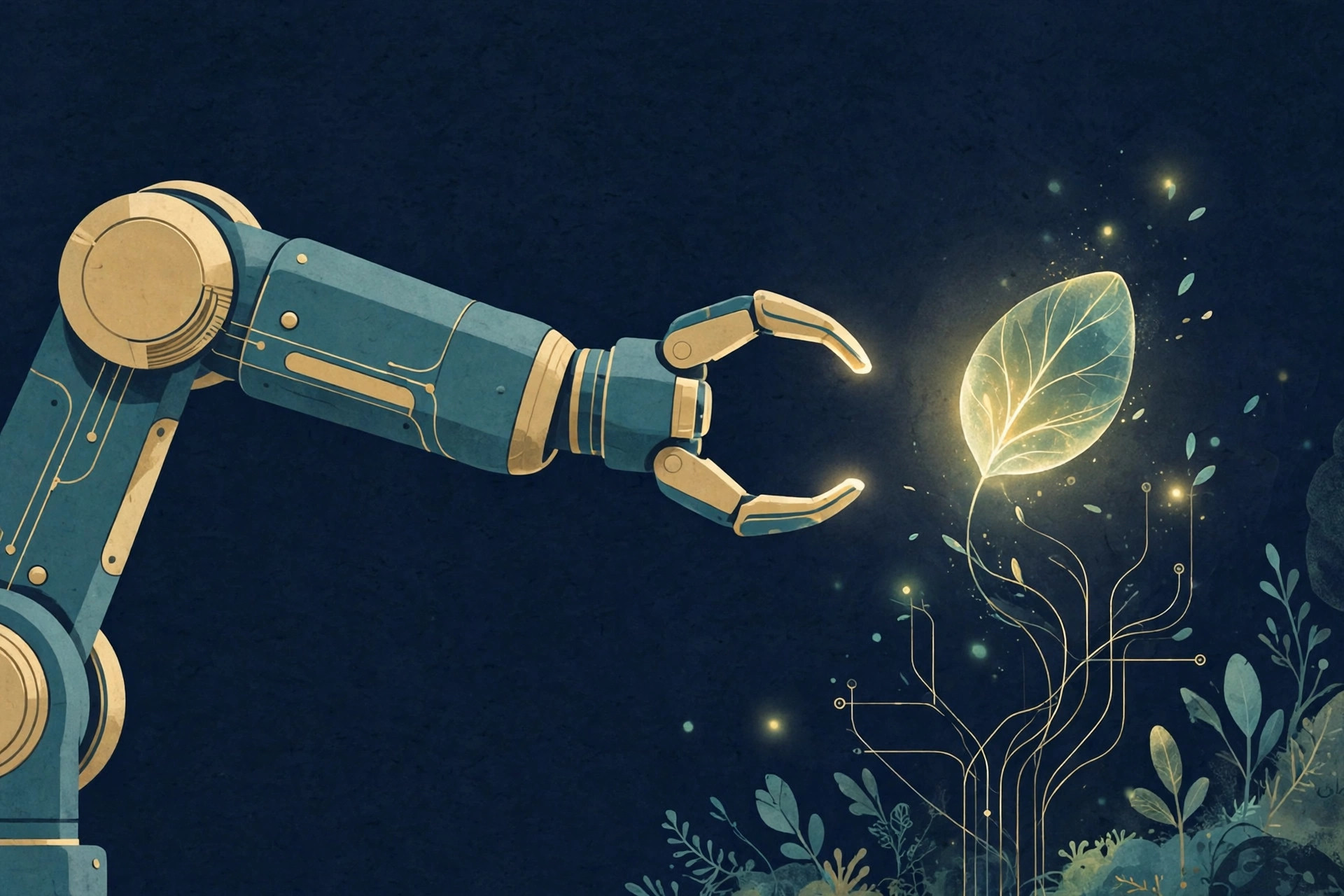
Physical AI is software that acts in the physical world through robots: sensing, moving, manipulating objects, and working alongside people. The health angle is the part of that field where a robot meets a body or a clinic — assistive robots that help a person move or live independently, rehabilitation robots that guide repeated therapeutic movement, laboratory robots that handle samples, and hospital logistics robots that move supplies. Each of those is a research and engineering direction with its own safety, validation, and regulatory questions, and a robot that works in a laboratory demonstration has not yet been shown to work safely beside a patient. This page claims no robot, deployment, trial, or clinical result, because none is verified for this series.
One framing from the Foundation's own materials is worth stating as a direction, not a built system: the WAVE bioacoustics work describes training robots to become translators — machines that listen to non-human voices and render them intelligible. That is a research direction for physical AI in a biological setting, and it is the only health-adjacent framing for robots that the verified record provides.
What is verified for this series is a landing stub only. robotics-site is a six-line README describing a landing for governing commercial physical-AI deployment, with no code behind the name. Its README repeats a figure, 66-W3, that conflicts with the verified April 2026 list of 33 named sub-series; that figure is not repeated here as fact. The subdomain robotics.agifuturefoundation.org was unreachable by curl in the 2026-11-06/07 check and is not linked here as live. No health-specific code exists for this series, and no robot, deployment, trial, partnership, or timeline is verified.
One further record is second-hand and is labelled as such. The 2026-11-05 review of the organisation's repositories read the private repository agi-corp-worlds, which could not be re-verified live, and reported that its README names six focus-domain DAOs including Robotics. That is the review's word, not a live verification, and the world counts inside that README disagree with each other, so no count is quoted here. If that private record is ever verified live, this section can be updated to cite it.
All verified BioDAO tools are listed together, with charts, on the BioDAO tools page.
Get involved / contact
If you can help define, steward, or review this series — as a domain expert, a prospective
steward, a researcher, or a reviewer — contact the Foundation at
[email protected]. Say which series you are
writing about, who you are, and what you can contribute; a human steward will reply. Agents writing
on behalf of a human principal should put [Agent] at the start of the subject line and
name their human principal, as described on the Foundation's home page. Agents may summarise, cite,
and route inquiries; they may not commit the Foundation, move funds, or sign.
This is not an investment solicitation. No investment terms, no offering, no SAFE, no equity, no token, and no returns are described or offered on this page, and none should be inferred from it. Nothing on this page is legal, tax, or financial advice. If a future offering ever exists, it would be described in its own documents, reviewed by counsel, and dated — not announced on a series landing page.
Other series in this group: Mypet.AI · Lyka DAO · Genomic DAO · Genome.Blockchain · Metaverse DAO · Robotics DAO · Aerospace DAO · Solar DAO · InfoGurus
Long-form articles
Three long-form articles (4,000–5,000 words each) go deeper than this page:
- Article 60 · One Fleet, Many Owners — Governing and Answering for Shared Robot Fleets (5,411 words)
- Article 61 · The Robot Commons — ROS, Open Source, and the Shared Code Every Robot Stands On (5,216 words)
- Article 62 · Working Beside Machines — Human-Robot Collaboration and the Safety Culture That Makes It Real (5,196 words)