Features · AGI Future Foundation
The First Company
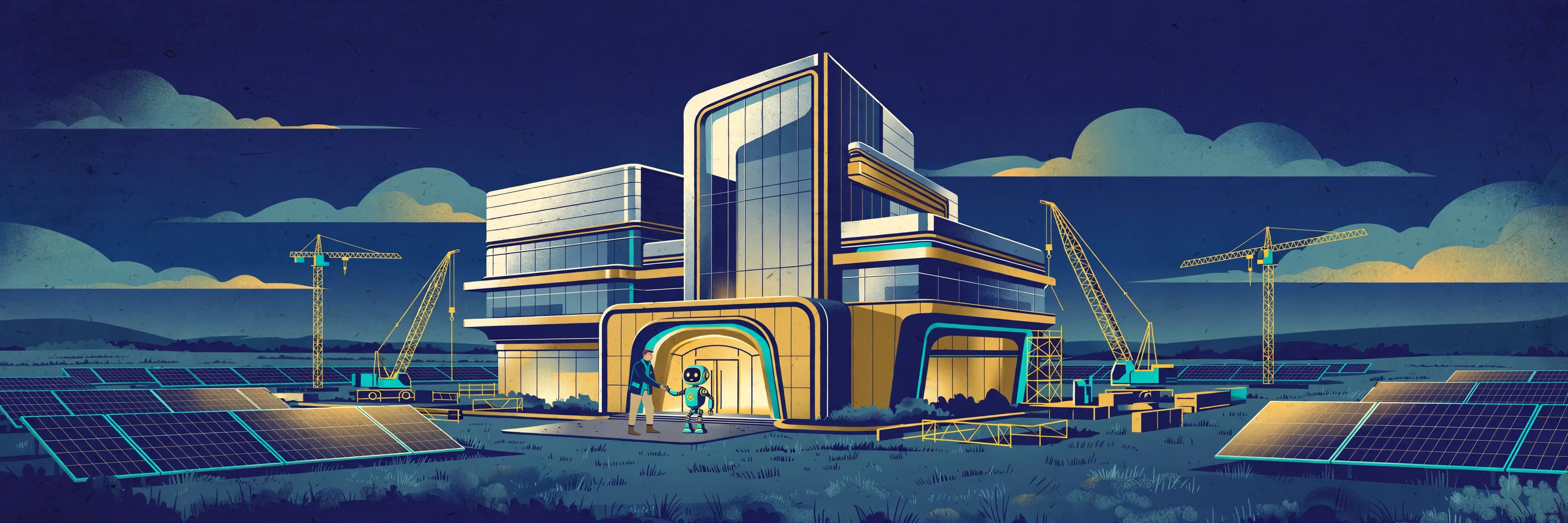
Every venture studio eventually faces the same question, and it is not a question about ideas. It is a question about paper: what legal shape does the first real company take, and who signs for it, and where does the money sit. The Foundation’s answer, written in November 2026, is a corporation that does not exist yet. SmartCiti.X, Inc. would be the first portfolio company of the agentic venture studio — a Delaware C-corporation, recommended but not decided, built to train people on robots, teach union trades with augmented and virtual reality, and manufacture robots in three American states where no site has been bought, no union has signed, and no customer has paid a dollar. This feature is about that plan in full: the tranches, the gates, the land, and the long list of things counsel still has to choose.
Why a corporation, and why this one first
The plan for SmartCiti.X began life as a series. In the April 2026 internal list of the Wyoming W3 LLC, SmartCiti.X is Series 10, one of 33 named sub-series, and the first version of its raise was written as a series raise: the issuer would have been W3 LLC, Series SmartCiti.X, and the money would have flowed through a series LLC instrument. That version is now superseded. On 2026-11-03, the plan was rewritten so that SmartCiti.X becomes a new, separate corporation, with its own charter and bylaws, its own employer identification number, its own bank account, and its own cap table. The raise issuer is the new corporation, not Series 10, and the two must never be presented as the same entity, and the same $10 million must never be raised through both. Series 10 remains a name on the internal list, and counsel must decide in writing what happens to it, without ever double-counting the same project or the same money in both places.
Why SmartCiti.X first is a separate question, and the answer is that it is the most developed idea in the family. The SmartCiti.X bundle in the Foundation’s GitHub organisation is the most substantive code in the whole review: a Trade Craft Academy implementation bundle, version 3.2, with an ACP protocol suite, a 111-hall roster, a 3,663-skill graph, eleven simulators, and its own self-verifying test suite. The world behind it has a Holodeck anchor, a dashboard, and tour geography in Louisiana and Indiana, and it is the first studio project raise in the valuations paper, ahead of every other series. That is why it leads. It is also why the plan is so careful about what it does not have: no audited financials, no signed union agreement, no site under contract, and no manufacturing revenue in the files reviewed. The suggested $25 million pre-money valuation sits below the Foundation’s own $50 million directed figure for the for-profit benefit-corporation track, and above the $100,000 to $500,000 range suggested for a generic pre-product series, because SmartCiti.X is positioned as a product-plus-sites series. A suggested valuation is still a suggestion, and the plan says so on every page that carries it.
The corporation would be the first studio portfolio company: a separate corporation, not a studio division, not a Foundation subsidiary, and not a Fellowship programme. AGI Corp remains the agentic venture studio, and it may invest in SmartCiti.X Corporation under a studio investment agreement with disclosed terms drafted by counsel, but that investment is a separate transaction from the external $10 million raise, and the same dollars must not be counted twice. The Foundation’s role is the mission gate, holding mission-fit approval and the Class C control shares, under written agreements rather than by owning the company.
Delaware, Wyoming, and the one-state rule
The plan recommends Delaware. A Delaware C-corporation is the recommended form, for reasons the plan borrows from the founder-stock and cap-table papers: Delaware corporate law is the one venture investors know best, the mechanics of preferred stock are cleanest there, and the YC-style SAFE form was built for Delaware corporations. Wyoming is the named alternative, to match AGI Corp’s intended Wyoming head, and counsel must choose one state in writing, weighing investor familiarity, franchise tax, foreign qualification in California, Louisiana, and Indiana, and compatibility with the SAFE form. The rule that matters most is the simplest: do not incorporate in both states.
Before any SAFE or equity is offered, the plan lists seven formation steps, and none of them is optional. First, name and trademark clearance: the proposed legal name is SmartCiti.X, Inc., but the exact name has to be cleared, because a brand is not the same as a cleared corporate name, and the full stop in SmartCiti.X may need handling under state filing rules. Second, a certificate of incorporation must be filed, carrying the benefit purpose, the Class A, B, and C authorisation, and the Windfall Clause reference, counsel to draft. Third, bylaws must be adopted and a board appointed, with names and roles blank in the plan, and no agent sits as a director. Fourth, a new employer identification number must be applied for in the corporation’s exact legal name, never reusing another entity’s number, and a bank account must be opened in the corporation’s name under a signed board resolution. Fifth, intellectual property must be assigned: all SmartCiti.X intellectual property assigned to the corporation by written assignment from every contributor before shares vest or a SAFE converts. Sixth, foreign qualification in every state where the corporation will operate, hire, or own real estate, with counsel to list them. Seventh, an accounting system and a cap-table system must be set up before the first close, because a corporation without a cap table on day one will misprice every later round.
There is a second choice inside the first one, and the plan refuses to let it blur. SmartCiti.X Corporation may be formed as a standard corporation or as a public benefit corporation, and counsel must choose one in writing. A benefit corporation carries a stated benefit purpose in its articles and an annual benefit report, and its directors must consider the benefit purpose alongside shareholder interests under California Corporations Code sections 14620 and 14621, with the expanded business-judgment protection those sections support. A standard corporation carries standard fiduciary duties and no benefit report. The plan’s rule is blunt: do not call the corporation a PBC in investor documents unless it is actually filed as one, and do not claim the expanded business-judgment protection of sections 14620 and 14621 for a standard corporation. If it is a benefit corporation, the section 14630 benefit report, or its Delaware equivalent, must be prepared and published. The Shield is expanded business judgment for benefit-considering decisions, subject to the duties in the statute and the articles. It is not immunity, and the plan corrects the pitch deck’s immunity language wherever it appears.
The formation checklist is also where the plan’s honesty shows most clearly, because every blank is left visible. Board size blank. Registered agent blank. Benefit purpose to be drafted by counsel. The plan does not fill a blank with a guess and call it a decision. It leaves the blank open and names the person who must fill it: counsel, the board, or both, in writing, before any filing or solicitation.
The money: twenty-five suggested, ten tranched
The capital plan is the most quoted part of the SmartCiti.X papers, and the most important part to read slowly. The suggested pre-money valuation is $25 million, for SmartCiti.X Corporation only — not for AGI Corp, not for W3, not for the Foundation, and never as one slice of a family total, because the papers forbid summing suggested valuations into a family figure. The suggested total raise is $10 million, in two tranches that are built into the plan rather than added later as an afterthought. Tranche 1 is $5 million at first close. Tranche 2 is $5 million at a milestone close. The second tranche does not release because a date arrives.
Tranche 1 is a seed close, and counsel must choose one instrument for it: a YC-style post-money SAFE, adapted to this corporation, or priced seed preferred. One instrument, one cap or price, not a menu. The suggested SAFE cap, if a SAFE is chosen, is $25 million post-money, a planning figure only. The first close pays for the beginning: site search and diligence, first-site deposits and closing costs, the first phase of the augmented and virtual reality curriculum build, the robotics training pilot setup, the manufacturing pilot setup, legal and compliance and accounting, and working capital. It closes only when the conditions are met: the corporation formed, board authorisation signed, intellectual property assigned, the bank account and accounting live, offering documents approved by counsel, and accredited-investor verification for a Regulation D raise, or a Form C and platform form for a Regulation CF tranche.
Tranche 2 is where the plan earns its discipline. It releases only when all five milestone gates are certified by the board in writing, and if a gate is missed, Tranche 2 does not release automatically. The board and the investors, as the signed documents provide, decide whether to waive, extend, re-price, or cancel it. A date alone never releases Tranche 2. The five gates are the plan, not a signed gate list, and they are: a signed union partnership agreement, with the union name blank because no union is named as a partner until it signs; an augmented and virtual reality curriculum pilot delivered, meaning a pilot cohort completed and the curriculum and simulator delivered, not merely built in a demonstration; a first site closed or leased, meaning a signed purchase or lease, not a site tour or a letter of intent alone; a first manufacturing order or pilot customer signed, meaning a paying pilot, because a non-binding interest letter is not a pilot customer; and financial reporting, meaning Tranche 1 use of proceeds reconciled to the bank and the accounting, with no commingling across entities, and a Windfall and benefit report drafted, even though the Windfall threshold is nowhere near triggered.
The price of Tranche 2 must be stated in the Tranche 1 documents, and the plan insists on this because the alternative is a dispute. Counsel and the board must choose one mechanism and write it down: fixed at the Tranche 1 price, capped at a stated figure, or re-priced at the milestone valuation. A Series A priced round is a future, separate round after that, with its price set then and not today. A Regulation A+ round is a later route, not part of the $10 million plan, and no Series A price, timing, or investor may be promised in the Tranche 1 documents.
The use of proceeds for the full $10 million is suggested, with the board to set the final percentages: $4 million for robotics manufacturing setup, meaning assembly, integration, testing, and small-batch production first, with full manufacturing only if capital and orders support it; $3 million for Louisiana and Indiana real-estate acquisition and fit-out, meaning the first sites’ acquisition costs and not an unlimited portfolio; $2 million for the union trades augmented and virtual reality training build, meaning curriculum, simulators, instructor onboarding, and pilot delivery; and $1 million for working capital, legal, compliance, accounting, and Windfall and benefit reporting. One rule governs every line: no use-of-proceeds line may be spent on another entity’s costs without a written, disclosed inter-entity agreement plus board approval. If the board prefers a studio management fee or a studio investment in SmartCiti.X Corporation, it must be a disclosed line in the offering documents, not a hidden deduction from the $10 million.
The fundraising route follows the corporate form. A corporate SAFE now fits, unlike the series LLC form it replaces, but the YC form still needs counsel’s adaptation for the Class A, B, and C structure and the Windfall Clause. The cleanest route for the full $10 million, in the plan’s judgment, is Regulation D for $10 million, accredited investors, SAFE or priced. The alternative is Regulation D for the $5 million first close plus Regulation CF of up to $5 million for the second tranche, on a platform form with a Form C, as a separate offering, and Regulation CF alone cannot raise $10 million, because its cap is $5 million. Platform fees must be modelled as net cash, not gross, in the offering documents. What must be disclosed in the offering documents, and not only in a deck, is a longer list: the corporation’s formation status, stated as filed or not; the Series 10 to corporation issuer change, so that an investor who saw the series plan is told the issuer changed; the Windfall blanks and the Class A, B, and C rights and the sovereign screening; the real-estate status, with no site under contract; the union and pilot status, with no union or customer signed; the corporate tax treatment, because corporate shareholders receive no K-1, and if an earlier Series 10 document promised one, it must be corrected in writing; and founder vesting and the cap table, fully diluted, including SAFEs, options, and platform equity or warrants.
Three states, three phases, no addresses
The real-estate plan is the part of the SmartCiti.X papers that reads most like a field manual. The geographies are three: Louisiana, Nebraska, and Indiana. Louisiana is the first launch state, and the tour and BuilderSpace geography, with new data-centre and jobs growth and a workforce and training need. Nebraska was added by the deep portfolio addendum of 2026-11-03, as tour and BuilderSpace geography around Omaha and Lincoln, also with new data-centre and jobs growth and a university and workforce presence. Indiana is retained from the original plan as the SmartCiti Holodeck anchor geography, with a manufacturing heritage and a workforce and training need. The addendum is explicit that Nebraska is an addition and Indiana is not removed, and that tour geography is not a site address for any state. The universities named on the tour site in Nebraska — the University of Nebraska Omaha, the University of Nebraska-Lincoln, and Creighton — are named there as university hosts. That does not make any university a SmartCiti.X partner, a site host, or a customer until a written agreement is signed. The Indiana anchor coordinates, 39.846, -86.622, are a world location, not a site purchase, and must never be presented as a site address.
The portfolio has a thesis, stated in plain terms and immediately qualified. Regions getting new growth and technology need trained workers for robotics and the trades, small-batch manufacturing capacity close to that growth, and housing for the people doing the training and the building. The qualification is the point: counsel and the board must test that thesis per site, on workforce demand, employer orders, zoning, and costs, and regional growth must not be presented as a guarantee of demand, revenue, or site appreciation. Regional growth does not prove a site will be profitable, and site values can fall.
The portfolio is built in three phases, and the phases are where the $10 million’s limits become visible. Phase P1, the first sites, runs on Tranche 1: the Louisiana launch site, combining manufacturing and training, plus site search and diligence in Nebraska and Indiana, with all site spending inside the $3 million first-sites envelope for acquisition and fit-out, unless the board increases the envelope in writing and states where the extra money comes from. Phase P2, the Louisiana launch and Louisiana purchases, runs on Tranche 2: Louisiana purchases of $2 million plus Louisiana fit-out of $1 million, with manufacturing scale-up, augmented and virtual reality expansion, and working capital, and Tranche 2 does not fund a Nebraska or Indiana purchase as its headline use unless the board amends the plan in writing. Phase P3, the Nebraska and Indiana portfolio build, is funded only by a future round, a Series A priced then and not today, or by operating revenue or lender financing as counsel and lender approve. P3 is a plan for a future round, not a commitment funded by the $10 million, and it must not be promised in Tranche 1 or Tranche 2 documents with sites, dates, or budgets.
Every property in the portfolio, in every phase, passes the same per-site gates, with no exceptions without a written board waiver stating the risk. R0 is criteria and search, before any deposit: board-approved site criteria covering workforce access, manufacturing suitability, training suitability, cost discipline with a per-site cap set by the board, and legal diligence. R1 is diligence, before closing: title search, survey, zoning confirmation or a stated variance path, environmental Phase I, an independent appraisal rather than a seller’s estimate, a building inspection, an insurance quote, and a lease-versus-purchase analysis per site. No site closes without R1 complete, and a skipped diligence item must be waived in writing by the board, with the risk stated. R2 is the acquisition structure, per site, a board and counsel and lender decision: purchase outright, financed purchase with lender terms never assumed, or lease with an option to purchase, where the option terms must be in the signed lease, because an option mentioned in a pitch is not an option. R3 is fit-out and opening, after closing or lease, with permits and inspections and insurance and safety sign-off before opening. A site is not open until those are complete. A fit-out photograph is not an opening. R4 is the second site, in Tranche 2, following R0 through R3 in full.
The portfolio holds three asset types under one owner, and the owner is always the corporation itself. Type M is manufacturing facilities: assembly, integration, testing, and small-batch production first, larger batches only if orders support it. Type T is training facilities: classrooms and simulator rooms and hands-on robotics and trades training space, with human instructors and journeymen as the credentialing authority, because agents build content and simulators and never certify a tradesperson. Type H is incubator housing: housing for resident founders, builders, trainees, and instructors connected to a SmartCiti.X facility in that region, for a defined residency period set by the board, under a residency agreement and a board-set fee, with zoning and safety in place before anyone moves in. Housing is not general public housing, not a hotel, and not a personal residence for any founder or director. A founder or director who lives in incubator housing must pay the board-set fee under the same residency agreement as any resident, or the arrangement must be disclosed as a related-party benefit and approved by the board. Investors own shares, not housing units, and housing revenue, if any, belongs to the corporation, reported as housing revenue. A housing property with no facility nearby is not part of the portfolio until the board approves it as a standalone housing asset in writing. The portfolio target over P1 through P3 is manufacturing plus training plus housing in each of Louisiana, Nebraska, and Indiana, built region by region and site by site, each site passing the gates, and the plan forbids presenting a count of properties as a commitment in investor documents. The target is a target, with the per-site gates as the control.
What the corporation actually does, and who it answers to
Strip away the tranches and the land, and the corporation does three things. Robotics training is hands-on industrial and service robotics training — safety, maintenance, programming — delivered as curriculum plus simulator plus instructor-led teaching, with human instructors as the credentialing authority. Union trades augmented and virtual reality training is augmented and virtual reality training for union trades, with the trade list to be confirmed with union partners, and no trade list promised in the plan until a union agreement is signed. Robotics manufacturing is assembly, integration, testing, and small-batch production first, with full manufacturing only if capital and orders support it. The plan puts customers first, seeking a paying pilot customer — a union, a training provider, a manufacturer, a workforce board, none of them named as a customer until signed — before or alongside the raise. A pilot customer is a signed agreement with payment terms, not an interest letter. The hiring plan names roles, not names, and no individual is promised a job in the plan. Agents assist with content, simulators, scheduling, and reporting. Agents do not hire or fire, sign, move funds, or certify a tradesperson.
Two relationships need stating because readers will assume them. The first is with Robotics DAO, Series 30 in the W3 list. Robotics DAO remains a background manufacturing-partner series, and it is not the corporation, not a co-issuer of the $10 million, and not a double raise. Any manufacturing partnership with Series 30 must be a written agreement between the corporation and the series, if the series is formed, with disclosed terms. The second is with the share structure, which is where the corporation form pays off most cleanly. Class A common stock carries one vote per share and full economic participation, and it is the class SAFE holders convert into and the class priced investors buy. Class B carries ten votes per share, is restricted to aligned partners and sovereign entities meeting strict safety and geopolitical frameworks, and is both economic and voting. Class C carries 1,000 votes per share, is held exclusively by the Foundation, and has no economic participation at all, control only, the Foundation’s ethical backstop. Founders must not be issued Class C, and founders’ economics vest over four years with a one-year cliff.
The Windfall Clause and Open Global Investment ride on the same corporate frame. The Windfall Clause would be incorporated into the charter and bylaws and into every SAFE and preferred agreement for this corporation, with the threshold as a percentage of global GDP, the Windfall Share, the administrator, and the segregated Windfall account all blank for counsel, and amendment only by supermajority plus the Class C vote, and survival on a sale, merger, or change of control to be confirmed in writing by counsel rather than assumed. Open Global Investment applies as in the pitch standards: broad ownership, ethical guardrails, and strategic inclusion, with participation in upside if there is upside, and never a guaranteed return. Class B and foreign investment are subject to sanctions and export-control and foreign-investment screening per jurisdiction, and the corporation may refuse, condition, or require restructuring of an investment that fails screening. No investor is promised a foreign market, a sovereign partnership, a government contract, a tax benefit, or a Windfall Bucket distribution. The pitch’s Gini figures are illustrations, not sourced statistics.
Governance closes the loop with transparency rules that are stricter than the plan’s critics might expect. Public use-of-proceeds summaries follow each close, showing gross, fees, net, spending by category, and remaining funds, not per day, and not projections presented as actuals. Investor updates go to major investors as the offering documents provide, covering the cap table fully diluted, financials, burn and runway, milestones against the plan, and material risks. Every published aggregate must reconcile to the bank and the accounting and to Form C or Form D as applicable, and if a number cannot be reconciled, it must not be published. The sequence of next steps is written in order: the board and counsel choose the state, the benefit-corporation question, the Tranche 1 instrument, the Tranche 2 price mechanism, and the Series 10 disposition, all in writing, before any filing or solicitation; then incorporation, bylaws, board, intellectual property assignment, bank account, accounting, and cap table; then site criteria approved and search begun, with no deposit until diligence is complete for that site; then offering documents approved by counsel and the Tranche 1 close; then pilot delivery, union agreement, first site, first order, and reporting, with board certification and the Tranche 2 close; then the second site and manufacturing scale-up only if orders support it, and Series A planning with the price set then and not today.
What exists today, what is planned, and the open questions
What exists today is a plan and a code bundle. The plan is the corporation paper dated 2026-11-03, with its tranches and real-estate addendum, and the truth audit that corrected it the same day. The code bundle is the SmartCiti.X repository in the Foundation’s GitHub organisation, a Trade Craft Academy implementation bundle, version 3.2, whose own self-test suite runs 9,267 checks, and whose roster lists 111 halls, with 0 of 111 signed off by a named practitioner, and whose own text states that a union named is not a partner or affiliate. What also exists is the filed Foundation, a California Nonprofit Public Benefit Corporation, Entity No. B20260196664, and the filed Fellowship, a separate church, and the April 2026 internal list naming 33 W3 sub-series, Series 1 through 33, a three-page internal printout dated 2026-04-03, not a Wyoming filing. Other materials have mentioned 35 cells and 34 worlds, and a 66-W3 figure remains unexplained; the counts do not agree, and this feature follows the internal list.
What does not exist is everything the plan needs to become a company. The corporation is not incorporated in Delaware or Wyoming. No certificate has been filed, no bylaws adopted, no board seated, no employer identification number applied for, no bank account opened, no cap table set up, no intellectual property assigned. No site has been purchased, leased, or placed under contract in Louisiana, Nebraska, or Indiana. No union has signed. No pilot customer has signed. No manufacturing order exists. No revenue is evidenced. No SAFE or equity has been issued, and no money has been raised. The plan’s own disclosure list for offering documents is the honest inventory of the gap: formation status, the Series 10 issuer change, the Windfall blanks, the Class A, B, and C rights, sovereign screening, real-estate status, union and pilot status, corporate tax treatment, founder vesting, and the fully diluted cap table. Until those are written, there is no offering, and this feature makes none.
The open questions are the work the plan is waiting on, and they are not small. Counsel must choose the state and the benefit-corporation question, one each, in writing. Counsel must choose the Tranche 1 instrument and the Tranche 2 price mechanism, one each, in writing. Counsel must decide the Series 10 disposition. Counsel must draft the certificate’s benefit purpose and the Windfall appendix, and set every blank in the Windfall Clause: the threshold percentage, the GDP measure, the profit measure, the scope, the Windfall Share, the administrator, the audit and dispute forum, and survival on a sale or merger. Counsel must confirm the share classes, the Class B framework, and the securities exemption for each tranche. The board must be seated, the intellectual property assigned, and the accounting and cap table live before the first close. The first site must pass R0 through R3 before it opens, and the first union, pilot, order, and report must all be certified before Tranche 2 releases. Until then, SmartCiti.X, Inc. is a plan with a name, a structure, and a discipline, and the discipline, if it holds, is what would make the first company worth building.
What this is / What it isn’t
What this is
- A proposed new corporation, SmartCiti.X, Inc., as the first studio portfolio company: Delaware C-corporation recommended, Wyoming as the alternative, with counsel to choose ONE state and ONE form, standard or benefit corporation.
- A capital plan in suggested figures only: $25 million suggested pre-money, $10 million suggested raise, $5 million first close plus $5 million milestone close on board certification of ALL five gates.
- A real-estate discipline: three states, three phases, three asset types, per-site gates R0 through R4, and no site, union, or customer named, because none has signed.
What it isn’t
- Not a formed company: not incorporated, not filed, not funded, and not an offering. No SAFE, equity, or share has been issued, and nothing here is a price, a term, or a promise of return.
- Not Series 10: the W3 LLC Series 10 raise is superseded by the corporation plan, and the same $10 million must never be raised through both, and the two must never be presented as the same entity.
- Not a property sale or a housing promise: investors own shares, not units or parcels; P3 sites are funded only by a later round; and a site under evaluation is never presented as owned or open.
Where to see it
The series page carries the SmartCiti.X story as a series: SmartCiti.X, Series S10, with the deep article at SmartCiti.X, article 33. The studio model behind the first-company plan is on the Studio Model page, and the governance detail is on the Windfall Clause and Share Structure pages. The Trade Craft Academy bundle is public on GitHub: SmartCiti.X — a version 3.2 implementation bundle whose own self-test suite runs 9,267 checks, with a 111-hall roster of which 0 of 111 halls are signed off by a named practitioner, and whose own text states that a union named is not a partner or affiliate.
Nothing on this page is legal, tax, or financial advice. SmartCiti.X, Inc. is a proposed corporation, not a formed one, and the suggested valuation and raise figures are planning figures only. The Windfall Clause, the share classes, and Open Global Investment are draft designs with blanks for counsel to set.