Features · AGI Future Foundation
Worlds on Real Maps
Most virtual worlds start from nothing: a blank grid, an imagined coastline, a fantasy city drawn from a designer’s head. The Foundation’s worlds start from the opposite place — from the Earth itself. Satellite imagery for the ground underfoot. Elevation data for the hills and valleys. OpenStreetMap buildings for the streets a robot would actually drive down. A digital twin of a robot that has to learn to move through a space that already exists, with real dimensions, real obstacles, and real weather. That is the idea at the heart of WorldForge: training worlds built on real maps, so that what an agent learns in the virtual world transfers to the physical one. It is a strong idea, and it is, today, mostly a catalogue — hundreds of entries, six anchored fabrics, and zero worlds live on the platform they are meant to run on. This feature tells the whole road, including the parts where the road stops.
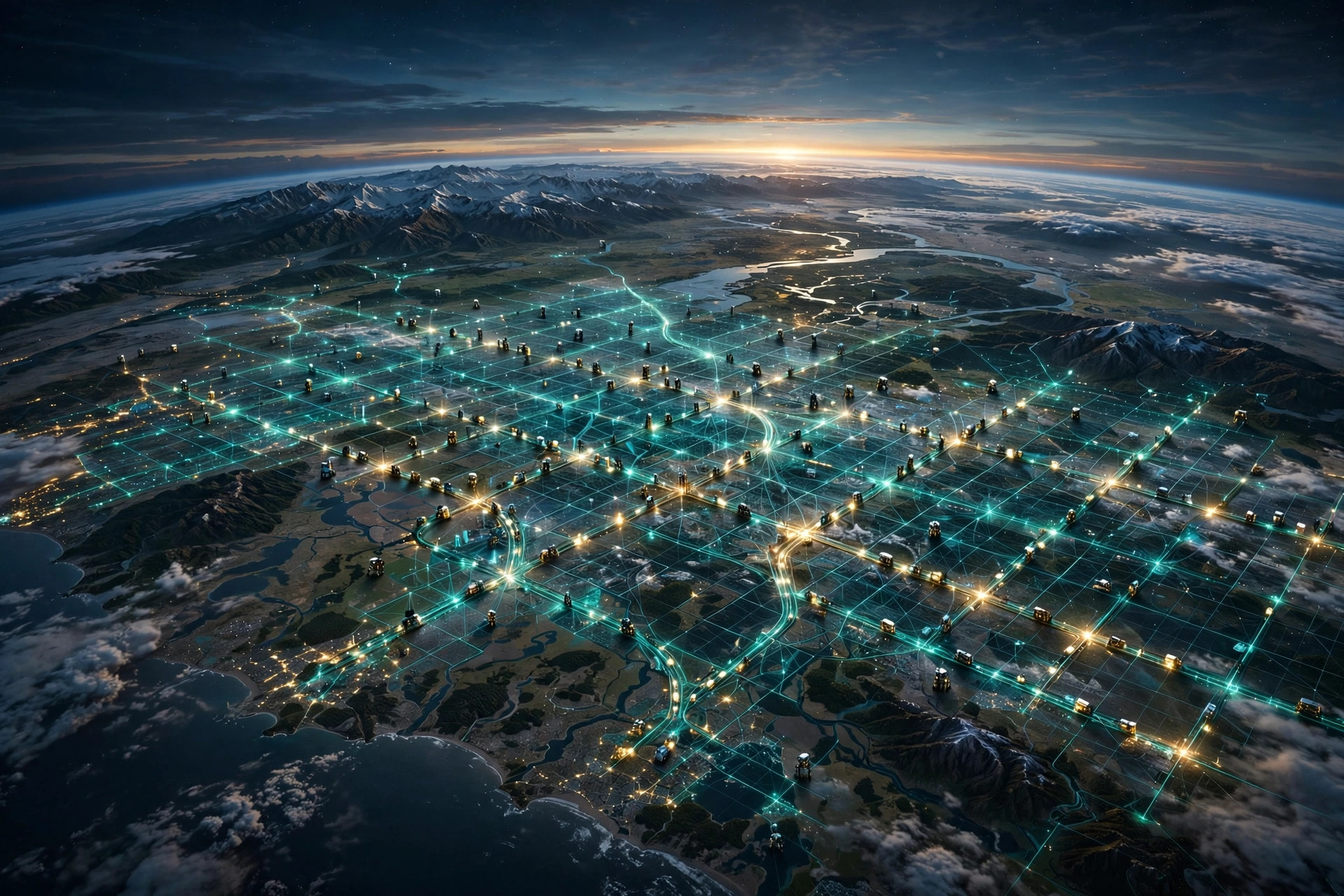
The map is the territory
There is a reason to build a training world on a real map, and it is not aesthetic. An agent trained in a made-up city learns the made-up city. An agent trained on a real street — with the real kerb heights, the real building footprints, the real slope of the road — learns something that transfers, because the thing it learned about is the thing it will meet. That is the bet behind WorldForge: closing the gap between the world an agent trains in and the world it has to work in, because a wrong lesson learned in simulation becomes a wrong turn on a real street. Building on real maps is the plan’s way of narrowing that gap before the training even starts.
The ingredients are, on paper, the right ones. Satellite imagery gives the world its ground truth — what is actually there, seen from above, rather than what a designer imagined. Elevation data gives it its shape — the hills a wheeled robot must climb, the valleys a flying one must cross, the slopes that change how a load behaves. OpenStreetMap buildings give it its structure — the streets, the blocks, the footprints of the places people actually live and work. And robot digital twins give it its actors: virtual versions of physical machines, with the same dimensions, the same movement limits, the same sensor ranges, so that a twin that learns to navigate a digital street is learning something true about the machine it stands for. Put together, those four ingredients are a serious toolkit for building training environments that mean something. The public WorldForge-Browser repository describes the project in exactly those terms — agentic training worlds on real Earth maps, with satellite imagery, elevation, OSM buildings, and robot digital twins — and its README counts forty-one of them. Forty-one is the curated first set, not the repo’s total: its worlds.json file holds 544 worlds, all with no RP1 attachment. That description is repository copy, and this feature quotes it as such — it is what the project says about itself, not an independent verification.
The idea matters beyond robotics, because a world built on a real map is also a world that can be used by people, not just machines. A trainee in the Trade Craft Academy, Series 10, could walk a digital twin of a real site before setting foot in it. A planner could test a change to a street before making it. Those uses are all planned, not operating — but they show why the map-first approach matters: a world that starts from the Earth can serve the people who live on it, not just the agents that train in it.
There is also a discipline in building on real maps that a made-up world never imposes. A real map cannot be fudged. The street is where the street is. The hill is as steep as the hill is. A designer who wants a gentler slope has to find a gentler place, not draw one. That discipline is valuable for honesty as well as training: a world built on a real map can be checked. Anyone can look up the coordinates and see whether the world matches the place, and the six anchored fabrics each carry coordinates, published in the open, that anyone can verify.
Four stages of a world
The word world is doing too much work in the Foundation’s materials, and the first job of this feature is to slow it down. A world can be four different things, at four different stages, and a world can be at stage one without being at stage four. Stage one is an entry in a catalogue: a line in a JSON file, with a name and a set of coordinates, saying that a world exists in the sense that it has been listed. Stage two is a fabric: a definition file, published where a viewer can reach it, describing the world’s terrain, structures, and assets. Stage three is a render: the world actually appearing, fully, in a browser — the terrain visible, the buildings standing, the assets loaded — verified with evidence, not asserted. Stage four is a live world: attached to RP1, the spatial-computing infrastructure, enterable by people, operating as a place rather than a file. Those are four different achievements, and confusing them is how a catalogue becomes a metaverse in a press release.
By that measure, the Foundation’s worlds are mostly at stage one, with six at stage two, none at stage three, and none at stage four. The WorldForge-Browser repository’s worlds file lists 544 entries, and every one of them records no RP1 attachment. The six anchored fabrics — Cognition, Empathic, Diagnostic, Locator, the SmartCiti.X Holodeck, and Biota — are at stage two: their fabric JSON files are published on GitHub Pages, but the roughly two hundred GLB assets and the map.wasm file they reference are not hosted, so they do not render fully in Artemis yet. Zero worlds are live on RP1, which is stage four.
The stage framework also explains why the work ahead is sequential rather than parallel. A world must be built, its assets hosted, and its render verified before any RP1 attach can even be attempted, and the attach itself is authorised world by world. The route to RP1 was authorised world by world, and the proof-of-concept push is described as urgent — but authorisation is a permission, not a schedule, and no world has yet been reported live there. The Foundation has a catalogue, six definitions, and a road. The road has not yet been walked.
That framing is not a criticism of the work done so far. Cataloguing and fabric-writing are real work, and they are the necessary first steps. A world cannot be rendered before it is defined, and it cannot be defined before it is listed. The problem is only when the first steps are presented as the last ones — when a list of 544 entries is quoted as 544 worlds, or a fabric file is described as a place you can visit. This feature keeps the stages visible so that the reader can see both the progress and the distance: the catalogue is large, the definitions are real, and the distance from a definition to a live world is the whole project.
The six anchors
Six fabric files are published on GitHub Pages as the Foundation’s anchored worlds, and they are the most concrete thing in this whole story — each one a file, each one a place, each one checkable. Cognition sits at 45.483, 18.572, and maps to Series 1. Empathic sits at 47.440, -179.350, and maps to Series 2. Diagnostic sits at 5.343, 101.566, and maps to Series 3. Locator sits at 21.097, 142.693, and maps to Series 8. The SmartCiti.X Holodeck sits at 39.846, -86.622, and maps to Series 10, where it would serve as a training and demonstration space for the Trade Craft Academy. And Biota sits at -38.713, -27.248 — anchored, published, and unnumbered. Five of the six map to series. The sixth does not, and this feature says so plainly rather than assigning it one.
Biota is the exception that proves the rule about not inventing mappings. Its fabric is published, its coordinates are verified, and it appears in the Foundation’s materials as Biota.blockchain — but Biota does not appear in the April 2026 internal list of 33 named W3 sub-series, and no document reviewed for this site assigns it a series number. This site does not assign it one. Inventing a number for Biota would corrupt the series list, mislead anyone counting the series, and create a false mapping that later work would have to undo. Biota is therefore recorded here exactly as it stands: anchored, published, and unnumbered, with the gap flagged for resolution. The remaining 28 series have no anchored fabric verified at all. WorldForge’s catalogue is therefore much larger than its anchored set, and the anchored set is much larger than anything live — a nesting of claims that collapses if the stages are confused.
All six fabrics share the same limit: their JSON files are live on GitHub Pages, but the roughly two hundred GLB assets and the map.wasm file they reference are not hosted, so none of the six renders fully in Artemis yet. Anchored therefore means defined and located, not live and not rendering. The work to finish them is straightforward to describe and real in effort: host the roughly two hundred GLB files and map.wasm where the fabric files can reach them, verify a full render in Artemis, and record the date and the result. The chosen demonstration route for the six anchored worlds is a Cloudflare tunnel — serving the fabric from the builder’s own machine so it can be seen and tested — chosen over a virtual private server map-service route. The tunnel setup was prepared; no public tunnel URL or rendered result had been reported by the time this feature was written.
The six anchors also carry a caution about coordinates that matters for everything that follows. The first 41 worlds in the WorldForge set carry latitude and longitude values that differ from the agi-corp anchor coordinates, and the two sets must never be mixed in an RP1 attach. Attaching the wrong coordinates to the wrong world would put a world in the wrong place, and a training world in the wrong place teaches the wrong lesson.
The numbers that disagree
Several numbers circulate for WorldForge and the worlds around it, and they must not be blended into a single claim. Each is quoted below with its source, and none is quoted as a count of finished, rendering, inhabited worlds. The first number is 80 worlds, as stated on the Foundation site. That figure is quoted here as site copy, not as a verified fact. No document reviewed for this site explains how the 80 was counted — whether it is worlds built, worlds listed, worlds planned, or worlds in some other sense — and no independent count confirms it. Until a source explains the counting method, the honest way to quote it is exactly this: 80 worlds, as stated on the Foundation site.
The second number is 544 worlds in the WorldForge-Browser repository. The public repository contains a worlds file listing 544 worlds. That is a verified count of entries in a file, and it is the largest number in this story — which is precisely why it must not be quoted as 544 worlds built. An entry in a catalogue is not a finished world. What the file does verify, and what matters more than its length, is the attachment column: every one of the 544 entries records rp1 as null. Not one of the 544 is recorded as attached to RP1. That is consistent with the wider verified fact that zero worlds are live on RP1, and it is the single most important thing the repository file establishes.
The third set of numbers belongs to the private agi-corp-worlds repository, and it disagrees with itself: its description says 40 AGI Corp worlds, its README speaks of 41 coming-soon worlds and 34 chartered worlds, and its own table rows sum to 44 — while its claim of 28 W3 LLC series worlds contradicts the 33 named series in the April 2026 internal list. This feature does not quote any single one of those counts as fact, and does not resolve the disagreement by choosing a favourite. The structure is what can be described honestly: six anchored fabrics, and chartered worlds awaiting a founder focus rather than filled with a guess. Other Foundation materials have mentioned 34 worlds and 35 cells. Those figures disagree with both the 80 and the 544, and with the 33 named series. The safe counts on this site are the ones with a cited source: 33 named series in the April 2026 internal list, and 544 entries in the WorldForge-Browser worlds file, all with no RP1 attachment.
The honest response is not to pick the largest or the smallest, but to publish one dated note reconciling them — stating what each counts and which of them, if any, is the number to quote. Until that note exists, this feature’s rule stands: quote the number with its source, never without it, and never blend two numbers into one.
The road to RP1, told straight
RP1 is the spatial-computing infrastructure the Foundation’s planned metaverse presence would run on — the servers, services, and software that would let people enter shared virtual worlds, move through them, and interact with them and with each other. WorldForge builds worlds; RP1 is where those worlds would run. The honest headline is that nothing is running on it yet. Zero worlds are live on RP1. No fabric or service has ever been attached for AGI Corp. The six anchored fabric files are published on GitHub Pages, but the roughly two hundred GLB assets and the map.wasm file they reference are not hosted, so they do not render fully in Artemis yet. That is the position, and this section will walk it component by component, because the components are where the story gets interesting — and where it gets thin.
First, the part that is genuinely live, and worth celebrating without reservation: WorldForge-Browser serves its curated worlds on GitHub Pages at the project’s earth address, a real deployed artifact that anyone can open in a browser. Pages-live is a real achievement — a public URL, serving real content, reachable today. But Pages-live is not RP1-live: the curated worlds are served as pages, not attached to RP1, and they do not render fully in Artemis, because the assets they reference are not hosted. Celebrating the Pages deployment and stating the RP1 gap in the same breath is not contradiction. It is accuracy.
Second, the components of the RP1 stack that have verified substance. Artemis is RP1’s native browser, in early alpha version 0.4.3, desktop only. VRS is a registry, and the Universal Map is the map that sits on it. Spatial Fabrics are hosted on your own infrastructure — in the Foundation’s case, on GitHub Pages — not hosted by RP1 as a service. And the Map Viewer is a database-backed editor, not a JSON renderer: it edits the database that holds map data, and it does not render a world from a JSON file. Those are the verified facts: a browser in alpha, a registry, a map, an editor with a known limit.
Third, the names — and this is where the grounding review changed the story. The RP1 ecosystem has seven named landing repositories: Sneeze, Rubidium, VRS, Statabase, RMAP, OMBI, and Artemis. All seven are empty repositories — not thin, not stubs, but empty, with no content at all, created on a single day alongside the rest of the landing family. They are names, reserved in the org, awaiting content, and must not be described as built sites. The RP1-ecosystem substance lives in one place only: the private agi-corp-worlds repository, which holds the fabrics and the RP1 export route via MSF_Map_Svc. That is where the real work is — the spatial fabrics, the agent swarms, the export route — and it is also where the counts disagree with themselves, as the previous section described. A stack that is partly built, mostly named, and partly a private repository with contradictory counts is not a working ecosystem. It is an ecosystem under construction.
Fourth, the road itself: what would have to happen, in order, before anything on this page can be described as live. First, the assets: the roughly two hundred GLB files and map.wasm referenced by the six anchored fabrics would have to be hosted where the fabric files can reach them, and the hosting location recorded. Second, the render: a full render in Artemis would have to be verified and dated, with a screenshot or a log, for at least one fabric, and then for each of the others in turn. Third, the names: Sneeze, Rubidium, RMAP, Statabase, OMBI, VRS, and Artemis would each have to be described in writing, with their function stated and their build status evidenced, so they stop being names and start being components — or the names would have to be withdrawn from the site. Fourth, the attach: a single world would have to be attached to RP1 and verified live, with the evidence published, before any claim of a live world could be made — and that first live world would be one world, not proof that the stack, the catalogue, or the network is live. No timeline is given for any of these steps, because no timeline is verified.
Who governs the worlds
A catalogue of worlds needs a governor, and the plan names one: Metaverse DAO, W3 Series 29. The April 2026 internal W3 series list names it and gives no further description, so the scope on its series page is a planned focus drawn from what the name implies, labelled as planned throughout. The name implies a governance role for the metaverse itself: the series that would decide how the Foundation’s worlds are run, who can build in them, what agents may do there, and how the worlds relate to the series that anchor them. Metaverse DAO is not a world. It is not a place you visit, and it is not the owner of the six anchored worlds. The anchored worlds belong to their series — SmartCiti.X, Cognition.X, Locator.X, Biota.blockchain (unnumbered), Empathic.X, and Diagnostic.X — and this series governs none of them today. What is planned is a coordinating function: shared standards for worlds across the network, so that a visitor, a builder, or an agent encounters consistent rules about identity, safety, and conduct rather than a different regime in every world.
A DAO that writes standards for worlds nobody operates would be governing an empty room. The planned sequence is therefore worlds first in the sense that matters: defined fabrics, stated purposes, and real activity, with governance standards following the activity rather than preceding it in the abstract. If the DAO ever operates, its agenda would be practical rather than grand. It would need to decide how identity works across worlds, and what an agent must disclose about its operator and its human principal before it acts in-world; what conduct rules apply, who enforces them, and what appeal exists for someone who is sanctioned; how builders get space and what they owe in return; what data a world collects about visitors and where that data goes; and how a world is retired, including what happens to its contents and its records. It would also need to decide its own limits: which decisions belong to the DAO, which belong to the series that anchors each world, and which belong to the Foundation as mission gate. Those boundaries, written down and agreed, are the governance product. No such standards, no enforcement, and no membership exist today.
Validation for Metaverse DAO would be measured in adoption, not in documents. A set of standards that no world adopts is a draft, however well written. The planned path is to start with one world that has real activity and real stewards, agree a small set of rules with them, operate under those rules for a fixed period, and publish what worked and what did not — then extend to a second world only if the first asks for it. That is slower than announcing a network-wide constitution, and it is the only way the standards would be grounded in something real. Until there is a world with activity asking to be governed, Metaverse DAO remains a planned coordinating function awaiting something to coordinate. Its repo coverage, through WorldForge-Browser and the worldforge-site landing, is among the strongest in the network — Metaverse DAO is one of only eight of the 33 series with any repo coverage at all — but coverage is not governance, and a strong repo does not make a DAO.
Governance for the worlds, as planned, follows the model used across the intended W3 network. Day-to-day work would be agent-managed: agents would operate routine work within limits set in advance by humans. Humans decide, humans sign, and humans move funds. Agents do not sign documents, do not move money, do not hire or fire, do not offer securities, and do not enact doctrine or charters. A human Steward Council would hold decision authority, set the limits inside which agents may act, review what agents did, and remain accountable. That model is itself planned, not operating: no Steward Council roster, operating agreement, or published set of agent limits exists today. The Foundation’s role in the intended structure is as mission steward, under written mission agreements, with its board remaining independent: a California nonprofit cannot be owned or controlled by a for-profit head.
What exists today vs. what is planned
What exists today
- The WorldForge-Browser public repository and its 544-entry worlds file, all rp1: null.
- Six anchored fabric JSONs on GitHub Pages, with their coordinates verified — and roughly 200 GLB assets plus map.wasm not hosted, so none renders fully in Artemis yet.
- A real deployed artifact: WorldForge-Browser serves its curated worlds on GitHub Pages at its earth address. Pages-live is real; RP1-live is zero.
- The private agi-corp-worlds repository, holding the fabrics and the RP1 export route via MSF_Map_Svc — the only place in the org where RP1-ecosystem substance lives.
- The Foundation’s filing record: California Nonprofit Public Benefit Corporation, Entity No. B20260196664, filed 2026-04-24, EIN assigned 2026-05-07.
- This page, as a public statement of the numbers and their limits.
What does not exist today: no finished, fully rendering world is verified; no users, visitors, revenue, customers, or partners are verified for WorldForge; no team, timeline, or launch date is verified; the seven RP1-ecosystem landing repositories are empty; and zero worlds are live on RP1.
What is planned
- Host the roughly 200 GLB assets and map.wasm the anchored fabrics reference, and verify a full render in Artemis, with the date and result recorded.
- Explain or correct the 80-world site figure with a stated counting method, or withdraw it — and publish one dated note reconciling the 80, 544, 41, 40, 34, and 35 figures, stating what each counts.
- Describe Sneeze, Rubidium, RMAP, Statabase, OMBI, VRS, and Artemis in writing — what each does, and whether it is built — or withdraw the names.
- Resolve Biota’s missing series number with a document, not a guess.
- Pursue an RP1 attach world by world, only after a render is verified — and report the first live world with evidence, not assertion.
- Stand up Metaverse DAO’s governance only once a world with real activity asks to be governed, starting with one world and a small set of agreed rules.
Each step would need its own document or dated verification. None is presented here as done, scheduled, or promised by a date, because no date is verified. In particular, no timeline is given for a first live world on RP1: authorised world by world is a permission, not a schedule.
The gap between those two cards is the whole story of this page. WorldForge is real as a repository, a catalogue, and a Pages deployment — and it is unverified as a finished product with users. The work that has been done is cataloguing, fabric-writing, and publishing; the work that has not been done is hosting the assets, verifying a full render, and attaching a world to RP1.
The open questions
A feature like this one should end on the questions, because the questions are where the project will succeed or fail. The first is the counting question: which number is the number to quote, and who will publish the dated note that reconciles them. The second is the assets question: where will the roughly two hundred GLB files and map.wasm be hosted, and who will pay for the hosting. The third is the render question: when will the first full render in Artemis be verified, with evidence, and what happens if the render reveals that the fabrics need rework. The fourth is the names question: what do Sneeze, Rubidium, RMAP, Statabase, OMBI, VRS, and Artemis actually do, and will the empty repositories be filled or withdrawn. The fifth is the Biota question: what series number, if any, belongs to an anchored world that the internal list never named. The sixth is the governance question: which world will be the first to ask to be governed, and what will its stewards accept as the first small set of rules. The seventh is the transfer question, the one the whole idea rests on: does training on a real map actually transfer to the real place — and how will anyone know, except by testing it in the real place, with real robots, and publishing what happened.
None of those questions has an answer on the record today. That is not a criticism of the project; it is a description of where the project is. The catalogue is real, the fabrics are real, the Pages deployment is real, and the distance from those realities to a live world is the whole project. A world built on a real map can be checked against the real place — that checkability is the idea’s greatest strength, and this feature has tried to apply the same discipline to the idea itself.
Where to see it
The public repository for this project is WorldForge-Browser on GitHub, which serves its curated worlds on GitHub Pages — a real deployed artifact — while its worlds.json file holds 544 worlds, all with no RP1 attachment. The Foundation’s own project pages for the same work are WorldForge and RP1 Ecosystem, and the planned governing series is Metaverse DAO, W3 Series S29. The RP1-ecosystem substance in the org lives in the private agi-corp-worlds repository — fabrics and the MSF_Map_Svc export route — not in the seven empty landing repositories.
Contact: [email protected]. If this project interests you, write and say who you are, what you do, and what you would like to explore — research, a future partnership, volunteering, or a question about the Foundation’s mission. A human steward will read it. Please do not send money, do not ask for investment terms, and do not treat this page as an invitation to invest: there is no offering here, no price, no terms, and no return is promised or implied. What is genuinely useful at this stage is specific, verifiable help: a named contact in the field, a written source that corrects or confirms something on this page, a question that exposes a gap in the plan, or an offer to help host the assets or verify a render.
Nothing on this page is legal, tax, or financial advice, and no signing, membership, payment, investment, or offering is made here. WorldForge is intended/planned, not formed, funded, or offered. AGI Future Foundation is a California Nonprofit Public Benefit Corporation, Entity No. B20260196664, filed 2026-04-24. No IRS 501(c)(3) determination letter is on file, so no tax-exempt status or tax-deductible donations are claimed.
← Prev: The Physical-AI Governors | Next: The Shield and the Windfall →