Article 45 · Foundation · AGI Future Foundation
Stewardship Under California Law: What It Actually Means to Hold a Mission in Trust
“Stewardship” is the word the Foundation uses most often to describe its own job, and it is doing two different kinds of work at once. In ordinary language, a steward is someone who looks after something that belongs to someone else. In California law, stewardship is narrower and harder: it is the set of fiduciary duties that the directors of a nonprofit public benefit corporation owe to the corporation, to its charitable purpose, and, through the Attorney General, to the public. The first meaning is a promise. The second is a legal standard that can be enforced in court, with personal liability attached.

Illustration: a tree rooted inside a courthouse atrium. Generated illustration, not a photograph of any real place, person, or object.
The word that does two jobs
This article is about the second meaning, and about the gap between the two. The Foundation’s planning documents describe an ambitious design: a nonprofit foundation that holds the mission — safe, equitable, and socially beneficial artificial intelligence — while a family of companies does the building, and human stewards decide what gets built. That design borrows ideas from the Stanford Center on Philanthropy and Civil Society (Stanford PACS) and from the wider steward-ownership movement. But the design only works if the legal meaning of stewardship is respected first, because California law does not care what a foundation calls itself. It cares what its directors do, what its money does, and whether its assets stay dedicated to the charitable purpose stated in its Articles.
The stakes are not abstract. In October 2025, OpenAI’s nonprofit and the California Attorney General signed a memorandum of understanding about OpenAI’s restructuring, in which the Attorney General’s supervisory role over charitable assets was central. That episode is not the Foundation’s story, and this article claims no connection to it; it is cited because it shows, in the open, what California charity law does: it gives the Attorney General primary responsibility for supervising charitable trusts and public benefit corporations, and treats a nonprofit’s mission as something the public has an interest in, not something a board can quietly rewrite. The Foundation is a very small organisation with the same legal shape. The law that applied there applies here.
What the Foundation is, in the law’s own terms
A California nonprofit public benefit corporation is a specific legal creature, and its shape explains most of what follows. It is formed by filing Articles of Incorporation with the Secretary of State, as the Foundation did on 24 April 2026. It has no owners and no shareholders. It cannot distribute profits. Its assets are irrevocably dedicated to its charitable purpose, which means that if it ever dissolves, whatever is left must go to another exempt organisation or to a government for a public purpose — not to its founders, its directors, or its donors. That dedication is not a policy the board can change when it becomes inconvenient. It is baked into the Articles themselves, and the Attorney General has the power to enforce it.
The Foundation’s filed purpose covers safe, equitable, and socially beneficial artificial intelligence, and the research and coordination network that serves it. That purpose language matters twice over. First, it is the standard against which the board’s decisions will be judged: a director’s duty of obedience, discussed below, is the duty to keep the organisation faithful to that purpose. Second, it is the language the IRS will read when the Foundation applies for recognition of exemption under section 501(c)(3) — a separate process, described in the companion article in this series, The 501(c)(3) Determination Path. State incorporation and federal tax exemption are two different things, and the Foundation has the first and not the second.
The Foundation’s board is where stewardship becomes concrete. California law requires every nonprofit corporation to have a board of directors that manages the organisation’s activities and exercises its corporate powers, and a public benefit corporation must have at least three directors. The Foundation’s board is still being built: Russell Vacanti accepted a Foundation directorship on 6 November 2026, and a third director is sought. That is worth stating plainly, because a board’s duties are exercised collectively — through meetings, minutes, votes, and records — and a board that cannot muster a quorum cannot authorise anything at all.
| Verified fact | Detail |
|---|---|
| Legal form | California Nonprofit Public Benefit Corporation |
| Entity number | B20260196664 |
| Articles filed | 24 April 2026 |
| Secretary of State approval | 30 April 2026 |
| Principal / mailing address | 995 Market St, AGI Lab –10, San Francisco, CA 94103 |
| Agent | Mike Rice |
| EIN assigned | 7 May 2026 (IRS CP575A) |
| SF business registration | 6 May 2026 |
| IRS 501(c)(3) determination letter | None on file — not tax-exempt, donations not tax-deductible |
| Statement of Information | Due 23 July 2026 — overdue |
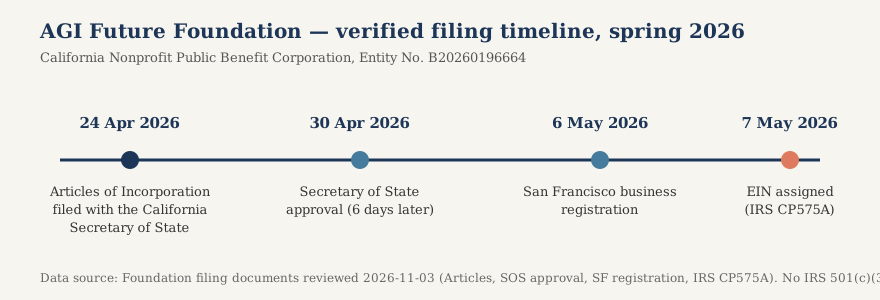
Chart: the Foundation’s verified filing timeline, spring 2026. Data source: Foundation filing documents reviewed 2026-11-03 (Articles, SOS approval, SF registration, IRS CP575A). No IRS 501(c)(3) determination letter is on file.
The three duties: care, loyalty, obedience
California law spells out the fiduciary duties of nonprofit directors with unusual specificity. The California Attorney General’s Guide for Charities and the Corporations Code describe three duties, and each one bites in a different way.
The duty of care requires each director to act in good faith, in a manner the director believes to be in the organisation’s best interests, and with the care — including reasonable inquiry — that an ordinarily prudent person in a similar position would use under similar circumstances. That standard is set out in California Corporations Code section 5231, as summarised in this guide to California nonprofit board duties. Notice what it demands: not brilliance, not success, but diligence. A director must read the papers before the meeting, ask questions when the answers are unclear, and make a reasonable inquiry before voting. A director who votes to approve a transaction they have not understood has failed a legal duty, not merely been careless.
The duty of loyalty requires directors to put the organisation’s interests ahead of their own. In practice this means avoiding situations where a director’s personal financial interests conflict with the nonprofit’s interests, disclosing potential conflicts before the board acts, and stepping out of any vote where the director is interested. California’s self-dealing statute, Corporations Code section 5233, as summarised here, sets out the rules: a transaction involving a director’s material financial interest is treated as a self-dealing transaction unless it meets specific statutory safe harbours, which generally require that the corporation entered the transaction for its own benefit, that the transaction was fair and reasonable at the time, that a majority of disinterested directors approved it in good faith with knowledge of the material facts, and that the board determined after reasonable investigation that no better alternative was available. The interested director cannot vote. Getting this wrong can lead to the Attorney General seeking to void the transaction and to hold the director personally liable. With narrow exceptions, a director or officer cannot borrow money from a charity at all, and a loan from a director to a charity must be on terms fair to the charity.
For the Foundation, the duty of loyalty has a sharp edge that the planning documents already recognise. The intended family structure puts the Foundation in relationship with for-profit entities — an intended Wyoming head company, AGI Corp, and a proposed series of operating companies — and with individuals who may hold roles on both sides of those relationships. A director who is also a founder, an investor, or an officer of a related for-profit company is walking directly into the territory section 5233 governs. That does not make the structure unlawful. It makes the process around it decisive: conflicts must be disclosed in writing, interested directors must recuse themselves, disinterested directors must investigate alternatives, and the minutes must show all of it. A structure that is lawful with clean process is unlawful without it.
The duty of obedience is the duty to ensure the organisation adheres to its mission and to applicable law and its governing documents. It is the least discussed of the three and the most important for the Foundation, because the Foundation’s entire design is a mission-lock design. Obedience means the board cannot quietly drift the purpose — from safe, equitable, and socially beneficial AI toward whatever is fashionable or fundable — and it cannot spend charitable assets on purposes outside the Articles. It also means the board must obey the law itself: filing the Statement of Information on time, registering with the Attorney General’s Registry of Charities and Fundraisers, filing annual financial reports, and keeping the records that prove all of it happened. The Foundation’s overdue Statement of Information is, in this light, not a clerical footnote. It is a small, visible failure of the duty of obedience, and the honest response is to file it and to build a compliance calendar that prevents the next one — not to minimise it.
The Attorney General: the public’s watchdog
The California Attorney General has primary responsibility for supervising charities, charitable trusts, and charitable fundraisers in the state. The Registry of Charities and Fundraisers administers the registration programme: charities that solicit donations in California must register and file annual financial disclosure reports, subject to limited exceptions. The Charitable Trusts Section investigates and brings legal actions against charities and fundraisers that misuse charitable assets or engage in fraudulent fundraising. The Attorney General must receive twenty days’ advance notice before a nonprofit corporation sells, leases, conveys, or otherwise disposes of all or substantially all of its assets.
This oversight is not theoretical, and it is not hostile. It exists because a charity’s assets belong, in a real legal sense, to the public purpose they were given for — not to the people running the charity. Donors give on the strength of a stated purpose, and the Attorney General is the party with standing to complain when the purpose is abandoned or the money is misapplied. Charities and their agents may not misrepresent how they use solicited donations, and once funds have been donated for a specific purpose, the charity has a fiduciary duty to spend those funds only on that purpose. A restricted gift — money given for a named programme — is not general revenue with a label on it. It is a trust, and spending it elsewhere is a breach.
For the Foundation, this has a practical consequence that shapes its fundraising. Until the Foundation is recognised as tax-exempt, it must not claim that donations are tax-deductible, and it must be careful in every solicitation about what it promises. The companion article on the determination path covers the donor-facing side in detail. The point here is structural: the Attorney General’s oversight is the backstop that makes the Foundation’s mission-lock credible. A mission lock that no one can enforce is a slogan. A mission lock backed by a regulator with the power to investigate, to sue, and to remove directors is a legal fact.
What the Foundation borrows from Stanford PACS — and what it does not
The Foundation’s planning documents describe the intended structure as the “Stanford model of philanthropy” as stewardship, borrowing principles associated with the Stanford Center on Philanthropy and Civil Society (Stanford PACS). Two clarifications matter here, and the Foundation’s own documents make both of them. First, this is a borrowing of principles, not an affiliation: Stanford PACS is a research centre at Stanford University, and the Foundation has no affiliation with Stanford, no endorsement from it, and no relationship to claim. Second, the principles being borrowed are about how philanthropy should be practised, not about corporate control.
Read against the Foundation’s design, the borrowing is real but partial. The Foundation takes from PACS the ideas of mission lock (the purpose is fixed and governs everything downstream), independent fiduciary governance (the board answers to the mission, not to any commercial parent), and pooled or segregated funds held for a stated purpose. What the Foundation does not take from PACS is a corporate control model, because PACS does not offer one. PACS studies philanthropy; it does not design holding companies. The leap from “a foundation should be governed by its mission” to “a foundation should run a family of operating companies through mission agreements” is the Foundation’s own design, and it must be judged on its own legal merits — which is where the hard tension in the next section comes in.
Steward-ownership elsewhere: useful comparisons, not precedents
The Foundation’s design also sits near a wider movement called steward-ownership, and the comparisons are instructive as long as they are not mistaken for precedents. Steward-ownership separates economic rights (the right to profits) from voting rights (the right to control the company), placing control in the hands of stewards legally obligated to uphold the company’s purpose, while profits serve the mission rather than being extracted. Its two core principles are self-governance — decisions taken by those connected to the mission rather than by external shareholders — and profits serving a purpose.
The best-known examples are real and long-lived. In Germany, the Robert Bosch Stiftung holds the overwhelming majority of shares in Bosch and reinvests profits in innovation and employees, and the Carl Zeiss Foundation holds all shares of Carl Zeiss. In the United States, Patagonia’s founder transferred all shares in 2022 to the Patagonia Purpose Trust, which safeguards the company’s values and independence, and the Holdfast Collective, a nonprofit that directs profits toward fighting climate change. Denmark has a large population of foundation-owned firms. These examples prove that the separation of control and economics can work over decades, and they prove something else too: that it works through specific legal instruments — foundation ownership, purpose trusts, dual-class shares, golden shares with veto rights over decisions that would undermine the mission — not through good intentions.
None of these examples is the Foundation’s structure, and the differences matter. Bosch and Zeiss are foundation-owned companies, where the foundation holds the shares. The Foundation’s design is different: the Foundation is a nonprofit that would steward companies it does not own, through written mission agreements, while an intended for-profit head company sits above the operating series. That is a more unusual shape, and it is more fragile, because the Foundation’s leverage would come from contracts rather than from ownership. Contracts can be breached, renegotiated, or allowed to lapse; ownership is harder to walk away from. The steward-ownership literature is clear that the legal instrument is the mission lock — the lock is only as strong as the document that creates it. For the Foundation, that means the mission agreements, the series charters, and the governance documents are not paperwork to be finished later. They are the entire mechanism. Until they exist, are signed, and are enforceable, there is no mission lock at all — only an intention to build one.
The Foundation’s own share-class design belongs to a different track and must not be confused with steward-ownership. The Class A, Class B, and Class C share structure, and the Windfall Clause, belong to the for-profit benefit-corporation pitch track only — a proposed company that has not been formed, funded, or offered. They are not part of the filed nonprofit, and they do not bind it. The nonprofit Foundation cannot issue shares, cannot promise returns, and cannot be owned. Keeping the two tracks visibly apart is not a matter of presentation. It is a matter of law, because a nonprofit that behaves as though it were a for-profit holding company risks its charitable status, its directors’ duties, and the Attorney General’s attention all at once.
The hard tension: a nonprofit cannot be owned
This is the point the Foundation’s own documents name most honestly, and it deserves to be stated without softening. A California nonprofit public benefit corporation cannot be owned or controlled by a for-profit head. Its board owes its fiduciary duties to the charitable mission and to the public, not to any commercial parent’s shareholders. Its assets are irrevocably dedicated to its charitable purpose. If the intended structure places AGI Corp — an intended Wyoming corporation that, at the time of writing, has an EIN only and no verified state filing — at the top of the family, with the Foundation beneath it, that structure cannot work as a chain of command. A for-profit company cannot direct a nonprofit’s board, cannot appoint and remove its directors at will for commercial reasons, cannot take its assets, and cannot treat its mission as a subsidiary objective.
The Foundation’s planning documents answer this tension with a single mechanism: control only via written mission agreements. The Foundation would set mission standards, and the operating companies would agree, in writing, to be bound by them — with the Foundation’s leverage coming from the agreement, from its role as the mission gate, and from its willingness to withdraw its name and its standards when the agreement is breached. That is a real mechanism, and it is used in the world: foundations, standard-setting bodies, and certification organisations all exercise influence through agreements rather than ownership. But it is a weaker mechanism than ownership, and it depends entirely on the quality of the agreements and the independence of the board that enforces them. A mission agreement that the Foundation’s board is unwilling to enforce — because the people on both sides of the table are the same people — is not a lock. It is a letterhead.
Three conditions therefore have to hold for the intended structure to be lawful and credible, and counsel must confirm each one in writing before the structure is used. First, the Foundation’s board must remain independent: a majority of directors with no material financial interest in the for-profit entities, exercising independent judgment, with conflicts disclosed and recused. Second, every agreement between the Foundation and a related for-profit entity must be on terms fair to the Foundation, approved by disinterested directors after reasonable investigation, and documented in minutes that show the investigation happened. Third, the Foundation’s charitable assets must never be used to subsidise a for-profit venture, and no Foundation funds may flow to a for-profit entity except on counsel’s written advice and on terms that serve the charitable purpose. These are the ordinary consequences of the duty of loyalty and the duty of obedience, applied to a related-party structure.
What stewardship looks like in practice
If the law is the standard, the practice is the calendar. A board that takes its duties seriously does a small number of unglamorous things, repeatedly, and keeps records of having done them. The Foundation’s compliance calendar — the schedule of filings, registrations, and reports that the law requires — is the most concrete expression of stewardship the Foundation has, because it is the place where the duty of obedience either happens or does not. The calendar, as it stands at the time of writing, looks like this.
| Obligation | Deadline | Status at time of writing |
|---|---|---|
| Statement of Information (SI-100) with the Secretary of State | Due 23 July 2026 (within 90 days of filing, then biennially) | Overdue — file before any bank application |
| Registration with the Attorney General’s Registry of Charities and Fundraisers | On soliciting donations or holding charitable assets | Not verified in the files reviewed — confirm with counsel |
| Annual financial report to the Registry (RRF-1) | Annually, with thresholds | Not yet due in practice; calendar it now |
| IRS Form 990 / 990-N | Annually after exemption is recognised | Not applicable until determination — calendar it now |
| IRS Form 1023 (application for recognition of exemption) | Within 27 months of the end of the month of formation for retroactive recognition (see companion article) | Not yet filed |
| San Francisco business registration renewal | Per city schedule | Registered 6 May 2026; calendar renewal |
| Board meetings with minutes | Regularly, per bylaws | Board still being seated; minutes must start at once |
That table is deliberately short, and its shortness is the point. The Foundation is a young organisation with a small footprint, and its compliance burden is correspondingly small. The danger is not that the burden is heavy. The danger is that a board absorbed in building a grand structure treats the small filings as beneath its attention, and discovers later that the grand structure rests on a lapsed registration.
Beyond the calendar, stewardship in practice means a handful of disciplines that the Foundation’s own documents already describe. Board meetings happen on a schedule, with an agenda circulated in advance, papers read before the meeting, and minutes that record what was decided, who voted, who recused themselves, and what was asked. A conflict-of-interest policy is adopted, signed annually by every director and officer, and actually used — not filed and forgotten. Financial records are kept so that any donation can be traced from receipt to expenditure, restricted gifts are tracked separately from unrestricted gifts, and no money moves without a second pair of eyes. The Foundation’s planning documents add a discipline specific to its design: agents may prepare, draft, research, and recommend, but only humans decide, sign, and move funds. That rule is the practical form of the duty of care and the duty of loyalty in an organisation that uses AI heavily: the legal responsibility must always land on a person who can be questioned, who can be held liable, and who can say no.
What still has to be done
This article has described stewardship as a legal standard. What the Foundation still has to do to meet it, stated plainly:
First, file the overdue Statement of Information, and do it before the Foundation’s bank application, since a lapsed filing is the kind of detail a bank’s compliance review will catch. Second, complete the board: seat a third director, adopt bylaws and a conflict-of-interest policy, and begin keeping minutes from the first meeting. Third, register with the Attorney General’s Registry of Charities and Fundraisers and set up the annual reporting calendar, so that the Foundation’s public filings tell the same story its website tells. Fourth, file the application for recognition of exemption under section 501(c)(3) — the subject of the companion article — and, until it is granted, be exact in every public statement that donations are not tax-deductible. Fifth, have counsel confirm in writing that the intended family structure — a nonprofit Foundation stewarding companies it does not own, through written mission agreements — is lawful as designed, and record the conditions counsel sets. Sixth, write the mission agreements before any company is asked to sign one, and make sure the Foundation’s board is independent enough to enforce them.
None of those steps is dramatic. None of them will make a headline. All of them are stewardship — the slow, documented, unglamorous work of holding something in trust for people who are not in the room. The Foundation’s ambition is to steward the development of artificial intelligence toward safety, equity, and social benefit. That ambition will be judged, in the end, not by the elegance of its structure but by whether its directors read the papers, asked the questions, filed the forms, kept the minutes, and said no when the mission required it.
Glossary
- Public benefit corporation — A California nonprofit corporation formed for charitable or public purposes. It has no owners or shareholders, cannot distribute profits, and its assets are irrevocably dedicated to its charitable purpose.
- Fiduciary duty — A legal obligation to act in another’s interests. For nonprofit directors: the duties of care, loyalty, and obedience.
- Duty of care — The duty to act in good faith, in the organisation’s best interests, with the care and reasonable inquiry of an ordinarily prudent person (Corp. Code § 5231).
- Duty of loyalty — The duty to put the organisation’s interests ahead of one’s own, including disclosing conflicts and avoiding self-dealing (Corp. Code § 5233).
- Duty of obedience — The duty to keep the organisation faithful to its stated mission, its governing documents, and the law.
- Irrevocable dedication — A public benefit corporation’s assets are permanently dedicated to its charitable purpose; on dissolution they must go to another exempt organisation or to government for a public purpose.
- Registry of Charities and Fundraisers — The Attorney General’s programme that registers charities and receives their annual financial reports.
- Self-dealing — A transaction between a charity and a director involving the director’s material financial interest, governed by Corp. Code § 5233.
- Statement of Information (SI-100) — The biennial filing with the Secretary of State reporting a corporation’s officers, directors, and agent.
- Steward-ownership — A model that separates economic rights from voting rights, placing control with stewards legally obligated to uphold the company’s purpose.
Frequently asked questions
Is the AGI Future Foundation a charity? It is a filed California Nonprofit Public Benefit Corporation, which is a state-law charitable form. It is not yet recognised by the IRS as tax-exempt under section 501(c)(3), because no determination letter is on file. State incorporation and federal tax exemption are different things.
Are donations to the Foundation tax-deductible? No — not until the IRS issues a determination letter recognising the Foundation as exempt under section 501(c)(3). The Foundation must not claim otherwise.
Who owns the Foundation? Nobody. A nonprofit public benefit corporation has no owners or shareholders. Its assets are irrevocably dedicated to its charitable purpose.
Can a for-profit company control the Foundation? No. The Foundation’s board owes its fiduciary duties to the charitable mission and the public, not to any commercial parent. The intended design relies on written mission agreements, not ownership or control, and counsel must confirm that design in writing.
What happens if a director puts their own interests first? The duty of loyalty and the self-dealing statute (Corp. Code § 5233) apply. The Attorney General can seek to void the transaction and hold the director personally liable.
What is the Foundation’s Statement of Information, and why does it matter? It is the biennial filing with the Secretary of State listing the corporation’s officers, directors, and agent. The Foundation’s was due 23 July 2026 and is overdue; it should be filed before the Foundation’s bank application.
Sources
- California Attorney General, Charities — oag.ca.gov/charities (fetched via Firecrawl, 7 November 2026): the Attorney General’s supervisory role, the Registry of Charities and Fundraisers, and the Charitable Trusts Section.
- California Attorney General, Attorney General’s Guide for Charities: Review and Discussion — oag.ca.gov/sites/all/files/agweb/pdfs/charities/publications/guide-webinar.pdf (found in search): duties of care and loyalty, self-dealing under section 5233, restricted gifts, and the Attorney General’s oversight.
- California Legislative Information, Corporations Code §§ 5231 (standard of care) and 5233 (self-dealing) — cited via California Nonprofit Law: Board of Directors Requirements — legalclarity.org/california-nonprofit-board-roles-and-legal-compliance (found in search): the duty of care standard, the self-dealing safe harbours, and the three-director minimum for public benefit corporations. (The leginfo pages for these sections were not fetched in this pass, so they are cited through this secondary source rather than linked directly.)
- Stanford PACS, Effective Philanthropy Learning Initiative — pacscenter.stanford.edu/research/effective-philanthropy-learning-initiative (found in search): the definition of effective philanthropy and the EPLI mission.
- Stanford PACS, Guide to Effective Philanthropy (2020), Introduction — ncfp.org (found in search): effective philanthropy as achieving objectives while avoiding unintended harm; focus, clear goals, and theory of change.
- Stanford PACS, “Making the Biggest Difference You Can” — pacscenter.stanford.edu/news/making-a-difference-learnep (found in search): perennial principles of effective philanthropy, including listening, multi-year unrestricted support, and transparency.
- Steward-ownership overview — becomingdenizen.com/essentials/steward-ownership (found in search): self-governance and profits-serving-purpose as the two principles; foundation-owned firms in Denmark; Patagonia’s Purpose Trust.
- Steward Ownership: Aligning Business with Long-Term Purpose — thecallingdigest.org (found in search): separation of voting and economic rights; Bosch and the Purpose Foundation.
- California Attorney General / OpenAI, Memorandum of Understanding re Notice of Conditions of Non-Objection (27 October 2025) — oag.ca.gov (found in search): the Attorney General’s supervisory role over charitable assets in a nonprofit restructuring.
- Local files: Foundation filing documents reviewed 2026-11-03 (Articles, SOS approval, SF registration, IRS CP575A); Structure v2 planning documents (2026-11-03); Venture Studio Operating Model;
~/workspace/your_files/hostinger-email/sites/agifuturefoundation.org/(site files).
This article is general information about California nonprofit law, not legal advice. The Foundation’s board should have counsel confirm every point before relying on it.