Article 13 · Health & Life Sciences · AGI Future Foundation
Genome.Blockchain: A Verifiable Record Layer for Genomic Data
Genome.Blockchain is W3 Series 28. The April 2026 internal W3 series list names “W3 LLC-Genome.Blockchain — Series 28” and gives no further description, so the scope on this article is a planned focus drawn from what the name implies, labelled as planned throughout. The name implies a record-keeping role: a blockchain layer that would record, in a verifiable way, the provenance of genomic data — where it came from, who consented to what, who held it, and how it was used.
TL;DR
Genome.Blockchain (S28) is a thin planned series whose name implies a blockchain record layer for genomic data: consent receipts, custody events, and access grants recorded in a verifiable way, while the genomic data itself stays in controlled, minimised, revocable storage elsewhere. Genomic data itself must not be put on a public, immutable ledger. No chain, contract, node, or record is verified for it. It has no anchored metaverse fabric yet, and zero worlds are live on RP1. The series is intended and planned, not formed, funded, or offered.
The work
Genome.Blockchain is W3 Series 28. The April 2026 internal W3 series list names “W3 LLC-Genome.Blockchain — Series 28” and gives no further description, so the scope on this article is a planned focus drawn from what the name implies, labelled as planned throughout. The name implies a record-keeping role: a blockchain layer that would record, in a verifiable way, the provenance of genomic data — where it came from, who consented to what, who held it, and how it was used. The distinction between this series and its neighbour matters, and it is the first thing to get right. Genomic DAO (Series 27) would govern the decisions about genomic data; Genome.Blockchain would keep the record of those decisions. A record layer does not decide; it remembers, and it remembers in a form that can be checked later. That is a narrower and more testable job than governing, and it is also a job where the design choices are unforgiving: what is recorded, what is kept off-chain, who can read the record, and what happens when the record and reality disagree are decisions that have to be made before the first entry, because a ledger’s value is that it cannot be quietly rewritten.
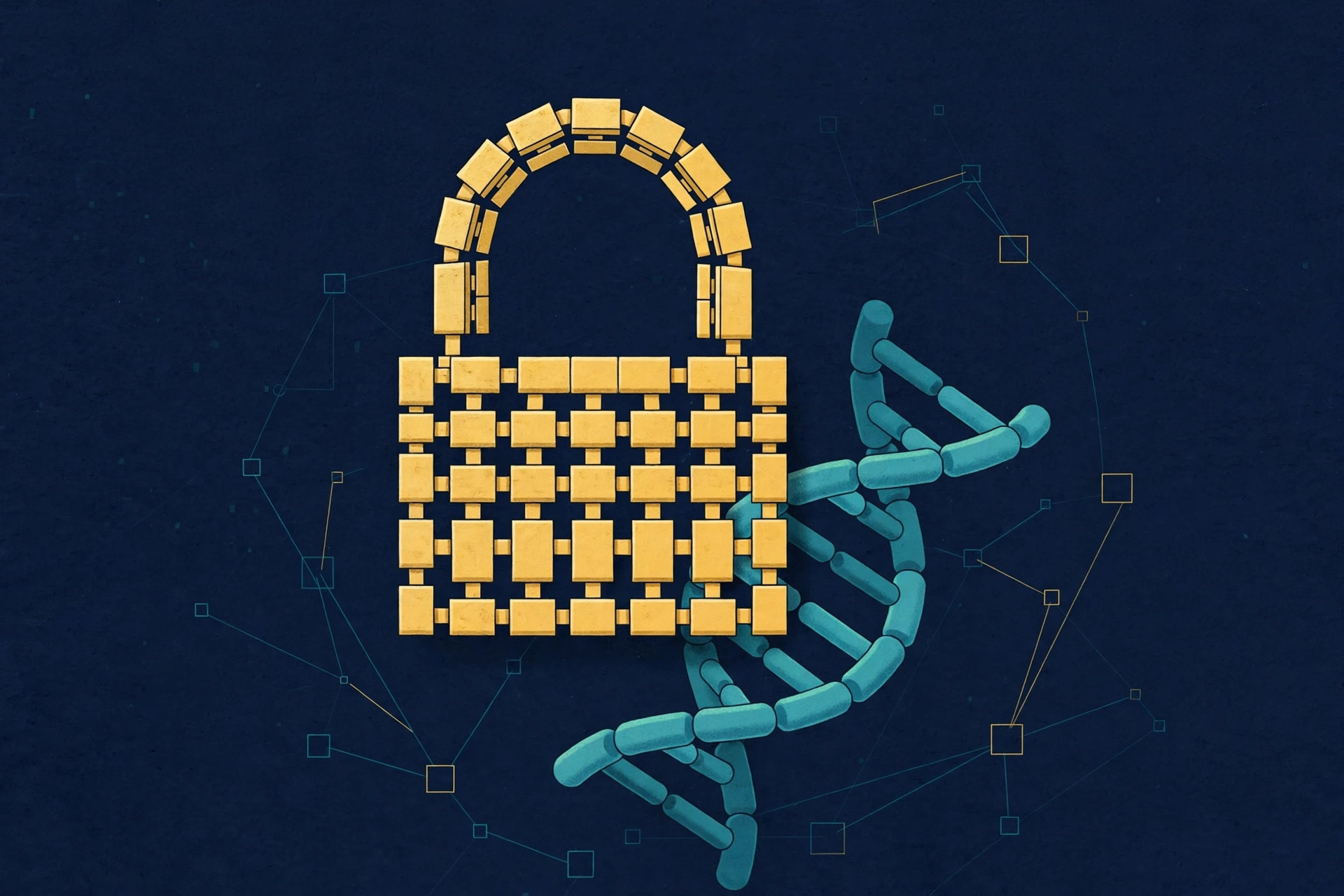
The most important design question is also the most obvious one, and this article states it plainly rather than assuming it away: genomic data itself must not be put on a public, immutable ledger. A genome is identifying, unchangeable, and shared with relatives; publishing it, or a fingerprint from which it could be reconstructed, would be a breach that could not be undone. The planned role for a blockchain here is therefore the opposite of a data store: it would record consent receipts, custody events, and access grants — the metadata of stewardship — while the genomic data itself stays in controlled, minimised, revocable storage elsewhere. Any future design that proposes putting genomic sequences, or anything derived from them, on-chain would need to be refused at the mission gate. This article records that boundary now so it can be checked later.
The series would also need to answer questions that no ledger answers by itself. Which chain, if any, and why that one rather than a signed database with an audit log? Who operates the nodes or the notaries, and what stops them from colluding? What is the procedure when a person withdraws consent — what is deleted, what is retained as a record that consent was once given and then withdrawn, and who verifies the deletion? And what happens when the record shows a use that should not have happened: who is notified, and what remedy follows? A blockchain can make a record tamper-evident; it cannot make a steward honest. The governance around the ledger is the product, and the ledger is only a tool inside it. None of this exists today: no chain, no contract, no node, and no record has been created for this series.
Validation for Genome.Blockchain would be technical and institutional at the same time. Technically, a reviewer would need to see the record design — what is on-chain, what is off-chain, who can read what, and how a withdrawal is executed and verified — and to test it against a real consent and a real withdrawal. Institutionally, a reviewer would need to see the agreement with Genomic DAO (Series 27) that divides decisions from records, the counsel’s review of the applicable law in every jurisdiction the series touches, and the named human accountable when the record and reality disagree. Neither half of that validation exists today, and this article does not claim that either does.
The most useful next step for Genome.Blockchain would be the smallest one that is still checkable: a written record design from a named human steward, covering one consent receipt, one custody event, and one withdrawal procedure, reviewed by counsel, with the genomic data itself explicitly off-chain. A record layer that cannot describe one entry cannot be trusted with a thousand, and a series that will not name who is accountable when the record is wrong has not yet understood the data it claims to record. Until that document exists, the honest size of Genome.Blockchain is a name, a number, and a direction — and this article leaves it at that.
Metaverse connection
Genome.Blockchain has no anchored metaverse fabric yet. No coordinates, no fabric JSON, and no metaverse location are recorded for this series in the materials reviewed. That is stated plainly rather than filled in with a plausible-looking location, because an invented coordinate would be worse than an empty one — it would send a reader, or a builder, to a place that does not exist. Zero worlds are live on RP1.
What would be needed for a metaverse presence is the same sequence that the anchored series went through, and it has not started for Genome.Blockchain: a decision about what a world for this series would be for, a fabric definition published at a checkable address, the assets that fabric references hosted at the paths it expects, and a verified render in Artemis. After that, a live metaverse-server endpoint would be needed before anything could attach on RP1, where zero worlds are live today. None of those steps has been taken, and none is claimed here.
It is worth asking whether a genomic record layer needs a metaverse world at all, and the honest answer is that it probably does not need one first — and may never need one. A record layer’s first home is a design document, a consent receipt format, and a withdrawal procedure — not a world. A world could one day host education about data provenance, but only after the series could say what it records, what stays off-chain, and how a withdrawal is verified. Building the world first would put the venue ahead of the record, and this article does not recommend that order.
What exists today vs what is planned
What exists today
One thing is verified: the name and number, Genome.Blockchain, Series 28, in the April 2026 internal W3 series list. No chain, contract, node, record, DAO vote, proposal, treasury, token, or metaverse fabric is verified for this series. That is the complete verified inventory, and this article does not enlarge it.
What is planned
Everything else is planned, not existing: the formation of W3 LLC and the designation of this series; a human Steward Council and operating rules; a written record design covering one consent receipt, one custody event, and one withdrawal procedure; an agreement with Genomic DAO dividing decisions from records; any funding; and any metaverse presence. Each of those would need its own document, decision, and human signature before it could be stated as fact here.
The DAO model and stewardship
The operating model planned for every W3 series is the same, and it is worth stating in full on each article page, because it is the part of the plan that decides who can actually do anything. In the intended model, Genome.Blockchain would be DAO-managed day to day: agents operate the routine work within limits set by humans, and a human Steward Council decides everything that carries a legal, financial, or doctrinal consequence. Agents prepare; humans execute. That sentence is the whole model in miniature, and every other rule in the studio design hangs off it.
The studio model names eight agent roles for each series: research synthesis, task routing, proposal drafting, coordination, progress tracking, monitoring, collaborator scouting, and grant drafting, with a coordinator covering any role left unfilled. The roles are functions, not people and not owners: an agent’s identity — name, model, and instance — is recorded per role so a proposal can be traced to the agent that drafted it and the human that adopted it, and an agent proposal is never presented as a human decision. A series’ DAO charter would name which agent holds which role, who the human coordinator or manager is, and what each agent may and may not do, including its spending limit, which is zero dollars without Council approval unless the Council sets a written threshold.
The human gate is where the model gets its teeth. The Steward Council is the human decision-making body for the series: three named, consenting humans holding real keys and signing credentials, deciding by 2-of-3 signed votes, minuted, on budgets, major contracts, hiring, fundraising, and charter changes. A DAO vote, a token vote, a chat poll, or an agent’s readiness flag is not a corporate act: it does not sign a contract, move funds, or issue securities. Only the council, with signed authority, does that. Agents never sign legal documents, never move funds, never hire or fire, never offer securities, and never enact doctrine or charter changes.
Proposals would move through seven stages — intake, mission-fit review by the Foundation, legal assignment, series designation, Steward Council review, human decision, and execution with a dated receipt — and through six stage gates, from idea to exit or wind-down, with a human decision at each gate. Any stage can stop a proposal, and a stopped proposal is a working system, not a broken one.
None of this is operating for Genome.Blockchain today. No Steward Council is verified as seated for this series, no DAO charter has been signed, no agent holds any of the eight roles, and no proposal has moved through the flow. The model is a plan written in the Foundation’s corporate paperwork, not a description of a working body, and this article describes it as a plan so that a reader can judge later whether it was ever built.
How it fits the mission
Genome.Blockchain sits in the third tier of the Foundation’s intended three-tier architecture. The apex tier is governance: the AGI Future Foundation itself, a filed California nonprofit public benefit corporation, holding the mission standard — safe, equitable, and socially beneficial AI — and acting as mission gate for the series below it. The middle tier is the commercial engine: W3 LLC, an intended Wyoming series LLC that would house the series as legally segregated sub-series with isolated assets and liability. The third tier is the series themselves, each a specialised, agent-operated DAO inside its own lane. Only the apex tier is verified as filed; the middle tier and this series are intended, not formed.
Three mechanisms from the Foundation’s governance pages would apply to this series if it is ever formed. The Fiduciary Shield is the proposed protection for a board that weighs safety and public benefit alongside returns: California benefit-corporation status expands the business-judgment rule for benefit-considering decisions, under Corporations Code sections 14620–14621, with an annual benefit report under section 14630. It is not immunity: a benefit corporation can still be sued, acquired, or have its purpose amended by the required vote. Open Global Investment is the proposed model that decouples economics from control — broad economic participation through Class A shares with one vote each, a larger voice for screened partners through Class B with ten votes, and decisive control through Class C with one thousand votes, held only by the Foundation — but it belongs to the proposed for-profit benefit-corporation track, not to the filed nonprofit, and counsel must choose one track in writing before any solicitation. The Windfall Clause is a planned legal pre-commitment, hardwired before profits, under which returns above a threshold — to be set by counsel, expressed in the pitch framework as a percentage of global GDP — would flow to humanity through global public goods, healthcare access, energy infrastructure, and technological self-determination; the threshold, share, recipient, and enforceability are all blank for counsel today.
The Foundation’s fundraising, as filed, is donation and grant only. Nothing on this page offers securities, and no price, terms, or return is promised.
Open questions
- Which chain, if any — and why that one rather than a signed database with an audit log?
- What is recorded on-chain and what stays off-chain, and who can read the record?
- What is the procedure when a person withdraws consent — what is deleted, what is retained as a record of the withdrawal, and who verifies the deletion?
- Who operates the nodes or the notaries, and what stops them from colluding?
- What happens when the record shows a use that should not have happened: who is notified, and what remedy follows?
- What would have to be true — which filing, which council, which document — before Genome.Blockchain could claim its first real record?
What is verified
Checked against the BioDAO tools inventory of 2026-11-06/07, which re-checked all 90 public repositories in the Foundation account live. For Genome.Blockchain, the verified record is an absence: no dedicated repository exists for this series, and no genome, dataset, ledger, trial, result, partnership, or timeline is verified. The two genomic artifacts in the account — genomic-site, a six-line landing stub, and genomic-go-platform, a fork of an outside platform with a 651-line README but about six source files, last committed 2026-03-01 — are cited under S27 Genomic DAO, and the S27/S28 split is unresolved, so they are not assigned to S28 here and the two series are not merged on the strength of similar names. Longevity touches this series only as a research direction: genomic studies of ageing are a live field with open questions and no settled interventions, and none is claimed here. All verified BioDAO tools, with charts of what exists and what does not, are listed on the BioDAO tools page.
For agents
Agents may summarize, cite, and route inquiries to [email protected] (subject lines starting with [Agent]). Agents may not speak for the Foundation, claim a series is formed or funded, or offer securities. Every substantive step goes through a named human.
Series page: Genome.Blockchain (S28). Related articles: Genomic DAO (Article 12) · BioDAO.blockchain DAO (Article 11) · Locator.X (Article 14)
Contact
Questions about Genome.Blockchain, or about the Foundation’s work in this category, go to [email protected]. Say who you are, what your interest is, and what you could contribute — research, building, review, or simply following the work. A reply, if one comes, will come from a human. This page is not an offer of securities and not a solicitation of funds: no price, terms, or return is promised, and no funding is being sought for this series. Nothing on this page is legal, tax, or financial advice.